
Content Management System (CMS): Architecture, database and publishing management

Content Management System (CMS): Architecture, database and publishing management
Content Management Systems (CMS) govern the authoring, storage, and omnichannel delivery of digital media. In modern architectures, headless CMS backends connect to edge frontends via structured APIs, as explored in our guide to API principles and software integration.
Content Management System or CMS is the set of procedures for managing the functioning of a cooperative environment, either manual or computer-based.
Data in the Content Management System may be almost anything: documents, films, pictures, telephone numbers, special figures, scientific data, so that content management systems are usually used to control, arrange and control existing documents; the Content Management System increases the issue number with each amendment to the file; the control of audits is one of the main features of the content management system.
They can also be defined as: integrated packages that constitute a content management system to be published and presented to visitors and members of the website, and provide tools to control the publishing process, which usually operate on the Internet, although they can also be operated on the local network.
Functions
Modern Content Management Systems provide structured governance across digital publishing lifecycles:
- Collaborative Multi-Author Content Authoring: Enables distributed editorial teams to draft, revise, and review content simultaneously with granular role-based permissions.
- Granular Access Control & Workflow Gates: Enforces review and approval hierarchies (e.g., Contributor -> Editor -> Legal Reviewer -> Publisher) before content can transition to live publication.
- Digital Asset Management (DAM): Centralizes storage, metadata tagging, versioning, and format transcoding for images, videos, PDFs, and technical documentation.
- Structured Data Modeling & Content Reusability: Models content into modular entities (articles, author profiles, categories) that can be queried and reused across web, mobile, and syndicated feeds.
- Audit Versioning & Change History: Automatically captures revision histories, diff comparisons, and rollback capabilities for every published asset.
Enterprise content management systems
The company content management system (English Enterprise Content Management or ECM) is the content, documentation and details relating to the company ' s operations.
| Architecture Type | Content Storage & Backend | Frontend Delivery Layer | Key Enterprise Tradeoff |
|---|---|---|---|
| Coupled / Traditional CMS | Monolithic database & admin UI (e.g., WordPress, Drupal) | Server-side rendered HTML templates tied directly to backend | Easy to deploy; monolithic dependencies and slower page performance |
| Decoupled CMS | Dedicated content database and editorial admin panel | Pre-rendered or separated frontend communicating via internal API | Improved security; requires frontend and backend coordination |
| Headless CMS | Cloud database exposed purely via GraphQL or REST APIs | Completely decoupled static site generators or mobile apps (Next.js, React) | Ultimate frontend flexibility and lightning-fast edge CDN caching |
| Component CMS (CCMS) | Granular structured XML/DITA modular component storage | Multi-channel publishing (print, web, mobile, technical documentation) | Maximizes modular content reuse across technical manuals and product docs |
Web content management systems
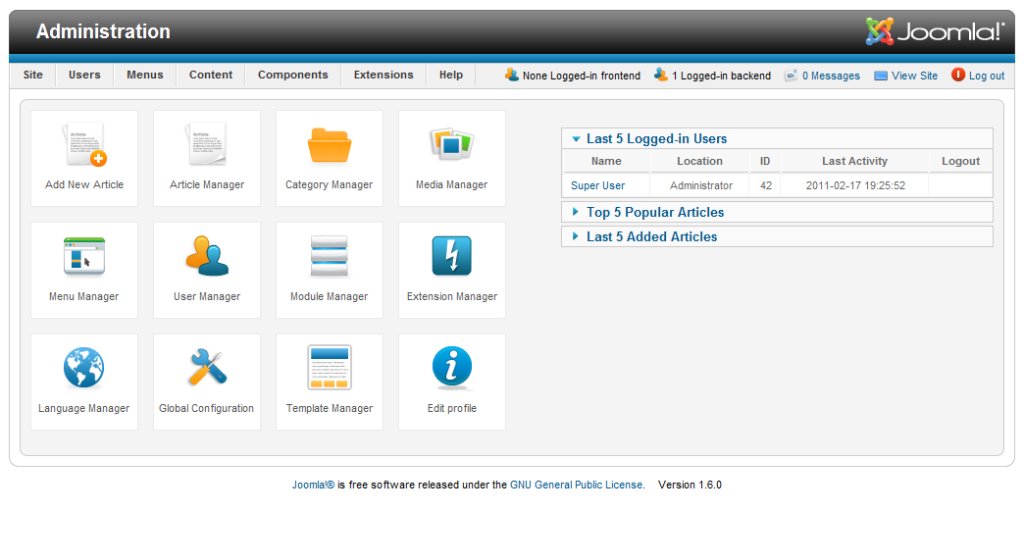 Joomla Web Content Management System (WCMS) Administration Control Panel Interface
The web content management system is a content management system designed to facilitate the dissemination of web content to portable sites and devices, and to allow, in particular, non-specialized content providers to send content without requiring prior knowledge of the HTML (HyperText Markup Language) code.
There are several web content management models, including codes, forums and portals. Codes use simplified content management systems that are oriented to personal use, and Wiki is another model of content management systems.
With the increasing complexity and correlation of content, as well as its size and the speed required by digital publishing, the use of information management systems on websites has become indispensable.
Component content management system
In the ingredient content management system, the storage and management of content at the level of parts of the document (components) is for a higher capacity to reuse those components.
The core functions of the content management system are:
Security management Component management server management Audit management
Content management systems
There are many content management systems, ranging from open-source platforms to proprietary enterprise solutions.


