
Electronic signature: Regulatory framework, legal validity and technical security

Electronic signature: Regulatory framework, legal validity and technical security
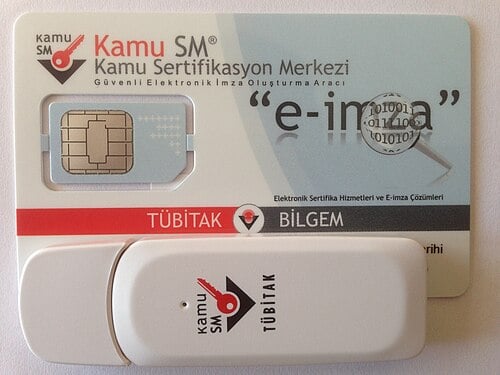 Secure Electronic Signature Creation Device with Smart Card and USB Cryptographic Token
Qualified Electronic Signature Creation Device (QSCD) featuring a smart card with embedded cryptographic chip and USB hardware security token for digital certificate storage.
Learn how electronic signatures provide legal validity, examine cryptographic foundations like public key infrastructure (PKI), and compare regulatory standards across the Americas and the European Union.
What is an Electronic Signature?
An electronic signature is a legal and technical mechanism that serves as the digital equivalent of a traditional handwritten signature. It consists of electronic data attached to or logically associated with a document, utilized by a signatory to signify acceptance, approval, and authorization of the document's contents.
Electronic signatures span a broad spectrum of authentication methods, ranging from basic clickwrap acknowledgments to highly secure cryptographic algorithms:
- Biometric Signatures: Capturing dynamic physical markers—such as handwritten signature pressure and stroke velocity on a digital pad, fingerprint scans, or facial recognition.
- Stylus & Touchscreen Capture: Using an electronic stylus, mouse, or touch screen to draw a visual cursive signature on a digital contract.
- Click-to-Sign Checkboxes: Checking an authenticated confirmation box or typing one's legal name into an electronic form to acknowledge terms and conditions.
- Cryptographic Digital Signatures: Applying asymmetric public key cryptography and hashing algorithms to cryptographically bind the signer's identity to the document contents.
- Credential-Based Signatures: Authenticating through single sign-on (SSO), secure username/password credentials, and time-based one-time passwords (TOTP).
- Two-Factor Coordinate Cards & Security Tokens: Using physical hardware security keys (FIDO2/WebAuthn), SMS verification codes, or banking coordinate cards.
Technical Foundations: Cryptography and Security Mechanisms
The evidentiary weight and technical reliability of an electronic signature depend on the underlying authentication and cryptographic techniques:
- Secret PINs & Passcodes: Knowledge-based authentication relying on confidential alphanumeric sequences known exclusively to the authorized user (e.g., ATM PINs or mobile unlock codes).
- Biometric Verification: Measuring physiological characteristics (fingerprints, iris patterns, facial geometry) and matching them against verified identity templates.
- Symmetric Key Cryptography: Utilizing a single shared secret key for both encryption and decryption. While computationally efficient, symmetric encryption requires pre-shared keys, making it impractical for open, multi-party business contracts.
- Asymmetric Key Cryptography (Public Key Infrastructure - PKI): Developed in 1976 by Whitfield Diffie and Martin Hellman, asymmetric cryptography utilizes mathematically linked key pairs:
- Private Key: Kept strictly secret by the signer, used to create the mathematical signature.
- Public Key: Published openly, used by any recipient to verify signature authenticity and ensure the document has not been altered since execution.
As explored in our technical analysis of digital signature cryptography and probative value, applying a secure cryptographic hash function (such as SHA-256) guarantees document tamper-evidence and non-repudiation.
Regulations in Different Countries
The legal validity of electronic signatures is recognized worldwide through national and international statutes.
The Americas
Across North and South America, electronic signature legislation generally adopts an enabling, technology-neutral approach, establishing that electronic signatures cannot be denied legal validity solely because they exist in electronic form:
- United States (ESIGN Act & UETA): The federal Electronic Signatures in Global and National Commerce Act (ESIGN, 2000) and the Uniform Electronic Transactions Act (UETA) establish that contracts, agreements, and records executed electronically possess the same legal force as paper-based handwritten signatures.
- Argentina (Digital Signature Law 25.506): Distinguishes between an electronic signature (generic digital verification) and a digital signature (cryptographically verified by a licensed certification authority, enjoying a legal presumption of authenticity).
- Chile (Law 19.799): Recognizes both simple electronic signatures and advanced electronic signatures certified by accredited certification service providers.
- Colombia (Law 527 of 1999): Defines digital data messages and electronic signatures, providing full legal validity for commercial transactions.
- Ecuador (Electronic Commerce and Data Messages Law): Regulates digital certificates issued by accredited entities (e.g., the Central Bank of Ecuador, Judicial Council), specifying mandatory certificate elements:
- Unambiguous subscriber identification and public key data.
- Certification Authority (CA) digital signature and accreditation details.
- Certificate serial number, issuance date, and validity expiration date.
- Statutory Exclusions Across the Americas: Most jurisdictions carve out narrow statutory exceptions where traditional paper and ink remain mandatory:
- Wills, testaments, and inheritance codicils.
- Family law matters (marriage, adoption, divorce decrees).
- Formal real estate conveyances requiring notarization on physical public deeds.
Europe: The eIDAS Regulation
In the European Union, the benchmark legal framework is Regulation (EU) No 910/2014, known as eIDAS (Electronic Identification, Authentication and Trust Services). Replacing the earlier 1999/93/EC Directive, eIDAS establishes uniform cross-border legal standards across all 27 EU member states.
As detailed in our specialized analysis of the eIDAS regulatory framework, eIDAS defines three distinct tiers of electronic signatures:
- Simple Electronic Signature (SES): Data in electronic form attached to or logically associated with other electronic data, used as an authentication method (e.g., email footers, basic checkboxes, scanned images of signatures). SES is legally admissible in court, but carries no statutory presumption of authenticity.
- Advanced Electronic Signature (AES): Meets four rigorous technical standards under eIDAS Article 26:
- Uniquely linked to the signatory.
- Capable of identifying the signatory.
- Created using electronic signature creation data that the signatory can maintain under their sole control.
- Linked to the signed document in such a manner that any subsequent modification is readily detectable.
- Qualified Electronic Signature (QES): An advanced electronic signature created by a Qualified Electronic Signature Creation Device (QSCD) and supported by a Qualified Digital Certificate issued by an accredited Trust Service Provider (QTSP). Under eIDAS Article 25(2), a QES has the exact legal equivalence of a handwritten signature and enjoys unconditional cross-border mutual recognition across all EU member states.
Best Practices for Enterprise Implementation
When integrating electronic signatures into contract reception apps or document workflow automation:
- Match Signature Tier to Risk Profile: Use Simple Electronic Signatures (SES) for routine employee surveys and internal memos; require Advanced (AES) or Qualified (QES) signatures for commercial vendor contracts, employment agreements, and regulatory filings.
- Maintain Comprehensive Audit Trails: Capture signer email addresses, IP addresses, signing timestamps, document hashes, and authentication events in a tamper-evident audit certificate.
- Enforce Secure Storage & Encryption: Store signed agreements and private cryptographic keys using industry-standard AES-256 encryption, adhering to data security best practices.
FAQ
Can an electronic signature be rejected in court?
Under both US federal law (ESIGN Act) and European law (eIDAS Article 25(1)), an electronic signature cannot be denied legal admissibility or validity simply because it is in electronic format.
What is the difference between an electronic signature and a digital signature?
"Electronic signature" is a broad legal term encompassing any electronic method used to indicate agreement. "Digital signature" refers specifically to the underlying mathematical and cryptographic implementation (using public key cryptography and hashing) that secures the document.
How long are digital certificates valid?
Digital certificates issued by commercial Certificate Authorities (CAs) typically remain valid for one to three years, after which they must be renewed to maintain cryptographic security.


