
Project management: methodologies, planning, and quality assurance of delivery

Project management: methodologies, planning, and quality assurance of delivery
Project management is the process of overseeing the work of a team to achieve all project objectives within specific constraints.1 This information is often documented in project documents prepared at the beginning of the development process, and the main challenges lie within the scope of the project, time and budget. The secondary challenge is to improve the allocation and application of inputs required to meet predetermined objectives.
Project management aims to produce a full-fledged project to achieve client objectives; in many cases, the objective is also to shape or modify the client ' s requirements to be realistically achievable; once the client ' s objectives are set, it should affect all decisions taken by project participants, such as project managers, designers, contractors and subcontractors.
Definition of project
The project here is a time-bound process or activity, that is, a date of commencement and an end date, which is done once to provide a product or service with a view to achieving meaningful change or adding value.
There is a difference between the fact that the project is one-time interim, and the administrative or operational processes that are carried out permanently or semi-permanently to provide the same product or service repeatedly; project management does not necessarily require the same requirements as the management of permanent administrative and operational processes, both in terms of the required technical skills and work philosophy, and hence the need to develop project management.
Herson (1992) defined a project as “any series of activities or tasks that have specific objectives that must be accomplished within specific specifications, have a specific beginning and end, have funding, and use different sources of money, time, equipment, and workers.”
Breman and others (1995) have been attributed to Lich and Turner (1990), defining the project as a " new industrial investment unit with certain distinctive or unique features through synchronization of time and cost ".
According to the 2 projects, it is a unique process, consisting of a range of coordinated activities and control of activities through start-up and completion dates, which is taken to achieve a target that conforms to specific requirements, including cost, time and resources constraints.
According to the 3 projects, time and cost of a restricted process to achieve a set of specific achievements that reach quality standards and requirements.
Difficulties and challenges
The first challenge of project management is to ensure that the project is achieved with specific constraints, and the second most ambitious challenge is to optimize and proportionate - or what is known as the statue - with regard to the allocation of inputs required to meet the previously defined objectives; there is an appropriate definition of the project as: a range of activities that use resources (either money, humans, raw materials, energy, space, arrangements, communications, or quality) or specific to the risks or quality) for purposes.
History of project management
As a science with its own rules, foundations and schools since the late nineteenth century and during the twentieth century, the Department has been enriched by a number of scholars whose studies and experiences have had a clear impact, and by Charles Babbage, who presented his management ideas in his book, published in 1832 entitled " Machines and Mactus " (The Economy of Machines and Manctures).
Henri Town also presented his management ideas in his article published in 1886 entitled " The Engineer as an Economist ", and Taun is the leader of the scientific management movement, followed by Henry Janet (H. Gantt), who developed the so-called 1917 blueprint (Gantt Chart).
Frederick Tyler (F. Taylor) also developed several literature, the most important of which was the book (the Principles of Scientific Management) published in 1911, then the French world, Henri Fayol, and his book published in 1916 (L’administration Industrielle et’Generale), and many scientists and researchers who have participated in the development of management science over the past decades.
After the Second World War, there was a need for scientific and practical ways to resolve management problems in large projects, and researchers were active in finding high-quality, quantitatively based methods, including two teams of advisers working in the United States of America and a third working group in the United Kingdom.
In the United States, a team of counsellors worked in collaboration with De Pont Chemical Industries and Remington Ran (Univac Division of Remington Ran) to develop a method of planning and management of maintenance operations at De Bont from December 1965 to February 1959.
This team has developed a method called planning and scheduling in the critical path (Critical Path Planning and Scheduling – CPPS), which was later known as the critical pathway method (CPM – Critical Path Method), where it was used to minimize the time required for maintenance at De Bont.
From 1954 to 1958, the other team worked in cooperation with the United States Marine Corps with Lockhead on the Polyares missile design and development project, developing a method called Program Evaluation and Review Technique – PER.
The third team worked in the United Kingdom in 1957 in the Operational Research Section of the Central Electricity Authority and developed a method - not later published - that was known as the longest unsuccessable route (The Longest Irreducible Sequence of Events), later known as the main sequence (Major Sequence), which led to good results in 1958.
1950s
In the 1950s, the project management era was initiated, as prior to this period project management was conducted informally, depending on the situation, position or project, often using the Janet scheme and some informal methods and tools. During this period, two mathematical models were developed to determine the project timeline:
The first is the method of evaluating and reviewing the project as part of the Polyares Inmarine missile programme of the United States Navy, in cooperation with Lockheed. The second is the critical route method developed jointly by the Dupont and Remington Rand companies for the management of production plant maintenance projects, which has spread rapidly in many private companies.
In 1969, the Institute for Project Management was established to serve the interests of project management. The foundation of the Institute was that project management tools and methods were spread from the software industry to the construction areas. In 1981, the Institute ' s Board of Directors announced the work of this document, which became the knowledge guide for project management (PMBOK) and included common standards and guidelines for all those exercising this specialization.
Project Lifecycle Governance & Stage-Gate Matrix
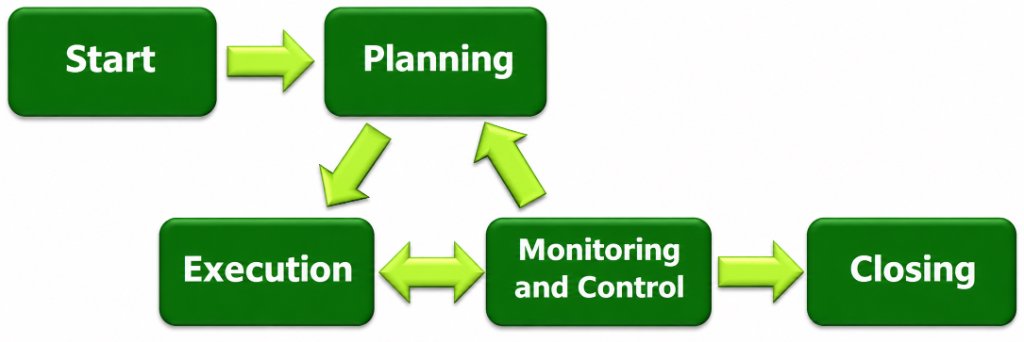 Project Management Lifecycle Process Groups: Start, Planning, Execution, Monitoring and Control, and Closing
| Lifecycle Phase | Primary Objective | Key Operational Activities | Stage-Gate Deliverable |
|---|---|---|---|
| Initiation | Establish project feasibility, charter, and business case | Stakeholder identification, scope definition, preliminary ROI | Approved Project Charter & Stakeholder Matrix |
| Planning | Formulate comprehensive schedule, budget, and resource plans | WBS creation, critical path modeling, risk assessment | Work Breakdown Structure & Baselined Project Plan |
| Execution | Coordinate team activities and build technical deliverables | Milestone execution, status tracking, vendor coordination | Functional System Deliverables & Work Products |
| Monitoring & Control | Track variances and enforce quality control standards | Burn-down tracking, earned value analysis, change control | Quality Audit Reports & Approved Change Requests |
| Project Closure | Finalize handoff, archive documentation, and evaluate performance | User acceptance sign-off, post-mortem, contract closure | Final Acceptance Sign-off & Retrospective Log |
The critical pathway method.
The critical-track method is a network-based tool that promotes project activities and their relationship prior to and beyond. Planning is defined as the development of the business structure of project activities. The schedule is for calculating the variables of activity (e.g. time, cost, number of persons). Project control means monitoring the scale during project implementation and updating and adjusting the methods of work or schedule accordingly.
Project planning
Project planning requires the development of the structure of work, which will later become the basis of a project continuity model; this model could subsequently be used in the evaluation of the project by comparing it with formal efficiency standards. Planning necessarily needs to match the project objectives with the organization ' s strategy and thus develop key performance indicators for performance follow-up.
Project efficiency measures
The three criteria for the efficiency of a project are time, cost and quality, and the overall objective of the project is often to implement the project in the shortest, less costly and of the highest quality. These objectives are realistically incompatible with each other, where in most cases the project is to be terminated at shorter and therefore more costly times, and if the quality of implementation is requested, the Director must find an appropriate public solution by balancing the achievement of the three objectives.
Time-to-cost balance
For a specific quality of a particular activity, the Director uses the materials, equipment and workers required to achieve the objective of the activity within less costly limits, and given that each activity must be carried out at the lowest cost, the entire project will be carried out at the lowest overall cost, but in order to shorten the time needed for a job, it is often called the cost of increasing the number of workers, requesting additional working hours from current workers or purchasing more efficient machinery and machinery.
Business relations
There are two possible relationships between a couple of businesses on the project network:
-
One of the jobs is just ahead of the other.
-
One business must follow the other directly.
If there is no previous and subsequent business relationship, business is supposed to be done in parallel. The former and subsequent business relationship is produced by absolute physical and technical constraints, safety factors, legal matters, and contingencies such as limited resources, methods of work or finance. The project manager is initially developing the business plan on the basis of absolute conditions, adding emergency circumstances to the work plan when needed to reach the project target, but the manager must anticipate and take them into account in order to avoid any delay in changing contingency plans in cases.
Work breakdown structure
The structure of the division of labour for a project is the scheduling of all individual activities that are the duration of these activities and their prior and subsequent relationships. Activities must be at the lowest cost and least vulnerable to the problems and contingencies of the project and, therefore, if the schedule resulting from the initial division of labour structure is feasible, it would be the optimum schedule, in the event that the schedule is not subject to implementation due to the time or resources available.


