
Software-as-a-Service (SaaS): Cloud model, deployment and licensing

Software-as-a-Service (SaaS): Cloud model, deployment and licensing
Software-as-a-Service - also known by its acronym SaaS - refers to cloud computing based service packages for the provision of application software, which enterprises and Organizations use when implementing their internal processes. The services associated with the provision are offered and provided by specialized providers via the Internet (based on existing Internet infrastructure).
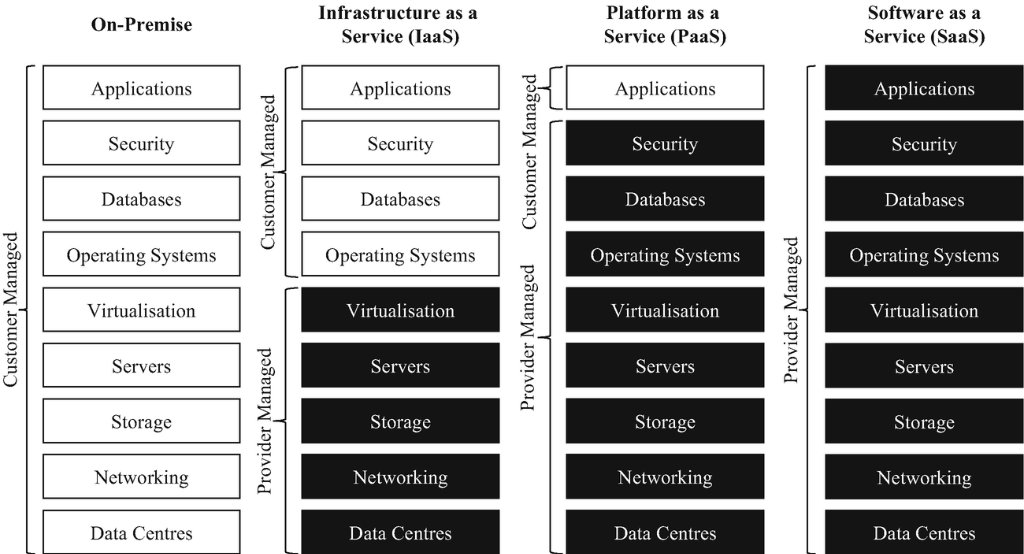 Comparison of On-Premise, IaaS, PaaS, and SaaS Managed Responsibility Layers
Further clarification of terminology
The SaaS model is based on the principle that the software and the IT infrastructure are operated by an external IT service provider and used by the customer as a service. To use online services, an internet-capable computer and an Internet connection to the external IT service provider are required. The software is usually accessed via a web browser.
The service recipient pays a usage fee for use and operation. Through the SaaS model, the acquisition and operating costs are passed on to the service recipient according to the principle of "pay according to the respective usage”, whereby the service provider usually takes over the complete IT administration and other services such as maintenance work and software updates independently. For this purpose, the IT infrastructure, including all administrative tasks, is outsourced and the service recipient can concentrate on its core business. However, the ultimate responsibility for proper use and implementation by the service provider remains with the service recipient.
In 1995, the GMD (now Fraunhofer FIT) introduced a system called BSCW that would today be referred to as the cloud. You could upload web-based documents to folders and share them with others. Since 1996, BSCW has been offered commercially by the Fraunhofer spin-off OrbiTeam.
SaaS vs. Perpetual Licensing Comparison
In the traditional license model, the IT infrastructure, the development of solutions and the software together represent a complex, expensive and risky investment. The customer purchases the software and thus receives the license to use the software. The provider provides the customer with an installation package. A separate IT infrastructure (hardware, operating system, database etc.) is required for the installation. Once installed, the software is configured according to business requirements. Once the software introduction is completed, the company takes over the operation of the IT infrastructure and the associated IT tasks.
In a professional environment, purchasing a license is often associated with a maintenance contract, which in turn includes follow-up costs. These include installing new releases and fixing software errors.
The basic idea of SaaS is similar to that of an electric utility company. The customer receives his electricity as needed. The customer does not manage their own generators, but the energy supplier takes over the necessary work for generating and distributing electricity. The customer only uses the electricity and pays a usage-dependent fee.
The basic idea described can be transferred to the SaaS model. The service provider provides, operates and performs the business software (e.g. an ERP system) or editorial software (e.g. an editorial system for technical documentation). technical support and advice. It takes over all the necessary components of a data center: networks, data storage, databases, application server, web server as well as disaster recovery and Data Backup Services. Other operational services such as authentication, availability, identity management, production control, patch management, activity monitoring, software upgrades and customizations are also carried out. The service recipient does not install his own software. All you need to use it is an internet-capable computer and an internet connection to the service provider. The software is accessed via a web browser.
The main difference between the models described above is that the IT infrastructure and IT tasks are no longer operated by the service recipient, but by the service provider. The service recipient no longer pays an entire software license, but rather a fixed fee.
Price models
The monthly fee depends on the service provider's pricing, as the SaaS model enables different pricing models:
Per user/month With this pricing model, the service recipient pays a consistent monthly fee for each registered user who works with the software. The user can use the software to its full extent, regardless of the number of transactions and the time, like a kind of "Flatrate”. He rents the software and the associated services. Dependence on the scope of functions This model is an extension of the first model (per user/month). The service recipient also pays a constant monthly fee, but this depends on the range of functions of the software used. The following example: If the service recipient uses the entire range of functions (for SAP, for example SRM, CRM, FI/CO, PRO, PM), the service recipient pays a monthly fee of 133,00 euros per user. With ten users, the service recipient would pay a total of 1330,00 euros per month for the software and IT services. If the service recipient only wants the CRM solution If you use the service, the monthly fee can be reduced.Depending on the number of transactions. There is a pricing model in which charges are made per transaction. For example, the service provider provides an e-commerce platform on which the service recipient can sell products. For each order generated in the shop, the service recipient pays a percentage of the sales price.Freemium With the Freemium pricing model, the service provider provides a basic version free of charge and supplements this with paid services.Free Trial / Shareware Very often, customers are offered a free trial phase where all or most of the functionalities can be tried out free of charge. The length of this phase is usually from a few days to a few weeks. There are also other pricing models, such as billing based on data volume or CPU hour used, or a constant price over a specific contract period. It should also be noted that the service recipient will not only be charged for the pricing models described above, but also implementation costs for extensive software products.
Advantages and disadvantages of Software-as-a-Service
From the service customer's perspective
The SaaS model offers small and medium-sized companies certain advantages, but also disadvantages compared to traditional license purchases:
Advantages
-
Low investment risk
-
Transparent IT costs
-
Accelerated implementation
-
Reducing IT process complexity
-
Mobility
-
Concentration on the core business.
The service recipient has a lower investment risk because he does not need any IT hardware to implement the software and only pays for the implementation consultation. Two studies from McKinsey & Company and Yankee Group show that the investment costs of a SaaS solution can be reduced by 30% compared to an on-premises solution, regardless of the number of users. In addition, the service recipient has transparent IT costs, as he usually only pays for the actual use of the software. Since SaaS solutions are usually standardized, the configuration and set-up of the application for new customers can be implemented more quickly and easily than with traditional license purchases. This means that a SaaS solution can be implemented within a short period of time. Another advantage is the outsourcing of process complexity by having maintenance work, updates and other IT tasks carried out by the service provider. Software access via the Internet ensures a high level of mobility, as the service recipient can access the system regardless of time and location. With an outsourced IT infrastructure, companies can concentrate on their core business or value creation and thus avoid IT tasks. With the new possibilities, the IT area of a company becomes more available to ensure growth, flexibility, competitiveness and thus the existence of the company, although, as shown in the following text, it is also more risky. In addition, the cloud environment offers all users (including business customers regardless of company size) the same security standards. Because the data is decentralized local hardware and software problems are less likely to lead to data loss.
Disadvantages
-
Dependence on the service provider
-
Under certain circumstances lower data transmission speed
-
Less adjustment options
-
Low data and transaction security.
It is to be regarded as a disadvantage that the service providers are in a dependency ratio, the so-called Vendor-Lock-in because the customer is not the owner of the software. There is a risk that the service provider will use the system for a specific reason (in case of insolvency) shut down. The service provider needs a functioning Internet connection. While many operators offer offline modes that allow working without the Internet – the data will be synchronized as soon as you go online again. However, a constant Internet connection is needed for optimal use of SaaS. A further disadvantage is the transmission speed of the data, which On-premises solutions is usually higher. The SaaS solutions are usually standardized so that there are few adjustment possibilities of the range of functions. Data security is also an important aspect. Confidential data are stored by the service provider so that they must be protected with appropriate security measures. Therefore, before using a SaaS solution, it is necessary to check whether the safety measures mentioned have been tested in accordance with certain safety standards. Such SaaS providers should be selected according to the data center standard, ISO ISO ISO 27001by the Federal Office for Information Security have been tested and certified. In addition, accountability (Art. 5 Abs. 2 GDPR), the rights of persons concerned (Artt. 12 ff.) with information obligations (Artt. 13, 14) and the obligation to data protection through technical design and data protection-friendly presetting (Art. 25) even after inclusion of Contractor/service providers (Art. 28 (or Art. 26) GDPR) continue and are subject to fines: the list of processing activities (Art. 30)the safety of processing (Art. 32 GDPR) and the notification of "Pannen” (Artt. 33, 34) and the privacy impact assessment (Art. 35 GDPR).
From the point of view of the service provider
The SaaS model also provides advantages and disadvantages for the service provider, which are described below:
Benefits
-
Enlargement of IT services and additional revenues
-
Long-term secured revenue and better liquidity planning option
-
Less probability of occurrence of Software piracy.
The service provider has the opportunity to expand its IT performance offering and thus generate further revenues. As the service provider usually pays a monthly fee for the use of the software, longer-term revenues can be secured and therefore liquidity can be better planned. In addition, fewer losses are achieved by the software piratery, as the software is centrally managed by the service provider.
Disadvantages
-
Investment risk
-
Acceptance problems in the IT market
-
Possible image damage and sales losses.
A disadvantage of the SaaS model is the high investment risk, as the procurement and management of the IT infrastructure is ensured by the service provider. Possible acceptance problems are usually based on lack of data security. In the event that the security measures are not complied with and sensitive company data reach external third parties, an enormous image damage with drastic sales losses could arise.
Data protection (GDPR)
At SaaS, the customer or employee data of the SaaS customer are no longer on their own computers, but on the SaaS provider. Between the customer and the provider of SaaS there is a regular case of Order processing by Art. 28 the General Data Protection Regulation (GDPR) before. The customer is obliged to carefully select the provider, Art. 28 Abs. 1 GDPR. The customer remains fully responsible for the legality of the data processing.
Contracts for the provision of SaaS must be one by type. 28 Abs. 3 GDPR include contract for order processing. Particular attention should be paid to the inclusion of subcontractors by the SaaS provider. These must be approved by the customer, changes are to be communicated to the customer and this receives a right of objection (Art. 28 Abs. 2 GDPR). Different from old law (before 25. May 2018) these contracts can now also be concluded in electronic form and do not require any signature. If a contract processing contract conforming to the GDPR is missing, the customer and now also the provider of sensitive fines of up to € 10 Mio. or 2% of global sales, Art. 83 Abs. 4 a.), 28 GDPR.
Worldwide revenue
In addition to Big Data, Data Warehousing and Marketplaces for Cloud Services, Software-as-a-Service has been identified as the most attractive technology field within a study. Largest SaaS company is Salesforce.com from California, about the same SAP from Germany. The concentration is in full swing. Examples include: Taleothe 2012 from the USA Oracle for 1,2 billions of dollars were taken over, then Paglo, which is already 2010 of Citrix has been taken over, or SuccessFactorsthe 2011 was taken over by SAP to name.
The market research company Gartner predicted for 2011 a turnover of 12,1 billions of US dollars. This means an increase of 20,7% compared to the previous year (2010: 10 billion dollars). The North American market represented the largest demand growth (2011: 7,7 billion dollars).
Gartner reported the share of SaaS in the CRM market 2012 on 40%. Revenue rose particularly sharply from IBMin the SaaS market of 2011 up to 2012 around 39,4% could accumulate. Salesforce.com, California's largest supplier, has increased its sales 26% on 2,5 billions of dollars, a similar increase as Microsoft. The European market leader SAP only slightly increased its sales 2,3 billions of dollars, which is partly due to exchange rate developments.
The SaaS market has grown significantly in recent years. Year 2021 SaaS's global spending amounted to around 152,2 billions of US dollars. For 2023 the forecast is more than 200 billions of US dollars.
Salesforce was 2020 with a market share of 9,3 Percent of the world's largest provider of software-as-a-service (Saxon). Other important players on the market are Microsoft, SAP and Google.
General:
Literature
-
Nico Weiner: The development and evaluation of business models for software as a service. (= series of publications on labor science and technology management; Bd. 30). Fraunhofer-Verl, Stuttgart 2015 [See also Diss. Univ. Stuttgart], ISBN 978-3-8396-0942-2.
-
Alexander Benlian et al. (Ed.): Software-as-a-Service: provider strategies, customer needs and value creation structures. Gabler, Wiesbaden 2010, ISBN 978-3-8349-2236-6.
-
Christiana Köhler-Schute (Ed.): Software as a service: SaaS: Strategies, concepts, solutions and legal frameworks. KS-Energy-Verl., Berlin 2009, ISBN 978-3-00-025765-0.
-
Florian Koch (Red.): Guide to SaaS providers. BITKOM, Berlin 2009. (PDF; 2,1 MB)
Special and adjacent topics:
Florian pastor: Drivers and barriers to the adoption of software-as-a-service in companies. Diss. Univ. Würzburg 2017.
Sebastian Stuckenberg: Exploring the organizational impact of Software-as-a-Service on software vendors: The role of organizational integration in Software-as-a-Service development and operation. (= Information technology and economics; Bd. 55) Verl. Peter Lang, Frankfurt am Main 2014, ISBN 978-3-631-65153-7.
Ali Amiri: The application grouping problem in Software-as-a-Service (Saxon) networks. In: Information technology and management. (ISSN 1385-951X) Bd. 23H. 2 (June 2022)S. 125–137.
Hans-Jürgen Appelrath, Henning Kagermann, Helmut Krcmar (ed.): Future Business Clouds: A contribution to the future project Internet-based services for the economy. (= acatech study) / acatech, German Academy of Engineering. Herbert Utz Verl., Munich 2014, ISBN 978-3-8316-4336-3.
Jewgenij Grobman: ERP systems On Demand: opportunities, risks, requirements, trends. Diplomica Verl., Hamburg 2008, ISBN 978-3-8366-6626-8.
Karlheinz Küting, Jim Hagemann Snabe, Andrea Rösinger, Johannes Wirth (ed.): Business process-based accounting: corporate transparency for the middle class with SAP Business ByDesign. 2., erw. Aufl., Schäffer-Poeschel, Stuttgart 2011, ISBN 978-3-7910-3090-6.
Gerald Münzl et al. (Red.): Cloud Computing – Evolution in Technology, Revolution in Business. BITKOM, Berlin 2009. (PDF; 4,1 MB)
Wolfgang Beinhauer (ed.): SOA for agile companies: understand, introduce and use service-oriented architectures. / With Beitr. v. Wolfgang Beinhauer, Michael Herr, Achim Schmidt. Symposion Publishing, Düsseldorf 2008, ISBN 978-3-939707-14-1.
-
Cloud computing
-
Grid computing
-
Utility Computing
Service-oriented architecture (SOA)
Web links
-
Andreas Gunten (2010): Software as a Service – A Paradigm Change, retrieved at 15. July 2010.
-
Computer Week (2008): Analysis of the Experton Group-The advantages and disadvantages of SaaS, 20. May 2008, retrieved at 16. July 2010
-
IT Business Edge (2011): Gartner: SaaS Growth Shows No Signs of Slowing, 14. September 2011, retrieved at 28. December 2011
-
Thomas Helbing (2018): (GDPR for IT service providers - The GDPR implement as processors), retrieved at 12. June 2018
-
Protective tips: Current version C5:2020 in the United Kingdom.
-
Skip to: 1 2 What is Software as a Service (Saxon)? - Definition of WhatIs.com. Retrieved 5.July 2023.


