
Digital Marketing: Channels, Acquisition Strategies, and Analytics

Digital Marketing: Channels, Acquisition Strategies, and Analytics
Digital marketing—also referred to as online marketing or internet marketing—encompasses all data-driven strategies, digital channels, and software platforms used to promote products, build brand equity, and optimize customer acquisition across the web. For foundational SaaS marketing models and formula benchmarks, review our guides in Article 009 and Article 037.
Electronic marketing tools
Modern digital marketing strategies leverage a diverse suite of digital tools and interactive communication channels:
- Search Engine Optimization (SEO): Optimizing web architecture and technical content to attract high-intent organic traffic from major search engines such as Google, Yahoo, and Bing.
- Social Media Marketing: Engaging audiences and running targeted campaigns across platforms including Facebook, Instagram, LinkedIn, TikTok, and X (Twitter).
- Multimedia & Video Streaming: Publishing high-impact video content and webinars on platforms such as YouTube and Vimeo to build brand authority.
- Affiliate & Referral Networks: Partnering with industry creators and third-party affiliates who promote products in exchange for performance commissions.
- Email & Lifecycle Marketing: Delivering segmented drip sequences, automated product onboarding, and behavioral newsletters to drive customer retention.
- Content & Blog Publishing: Utilizing enterprise CMS platforms such as WordPress to publish authoritative industry guides, case studies, and research reports.
- Performance Advertising (PPC): Deploying real-time programmatic ad campaigns across Google Ads, Meta Ads, and display networks with precise demographic targeting.
- User-Generated Content (UGC): Incentivizing customer reviews, unboxing videos, and community testimonials to provide authentic social proof.
- Growth Hacking & Experimentation: Applying rapid A/B testing across landing page copy, pricing tiers, and onboarding funnels to optimize user conversion velocity.
Advantages and disadvantages
Digital marketing allows organizations to cultivate direct, two-way relationships with prospects at unprecedented scale and velocity. Unlike traditional one-way broadcast media, digital channels enable continuous interactive dialogue, personalized recommendations, and dynamic behavioral segmentation.
While intrusive advertising or unsolicited email can trigger consumer resistance, transparent value-exchange models—such as interest-based opt-in newsletters and educational resource downloads—foster strong customer trust and brand loyalty. Furthermore, digital marketing operates under strict privacy and regulatory compliance frameworks, such as the EU General Data Protection Regulation (GDPR) and the California Consumer Privacy Act (CCPA), granting users the right to transparently access, rectify, and delete personal data.
From an economic perspective, digital marketing democratizes commercial visibility. An agile boutique startup can compete globally against established conglomerates by targeting specialized niche audiences. With low marginal production costs, immediate campaign adjustability, and real-time geographic targeting, digital campaigns deliver substantially higher return on investment (ROI) than traditional print or television advertising.
Difference between electronic and traditional marketing
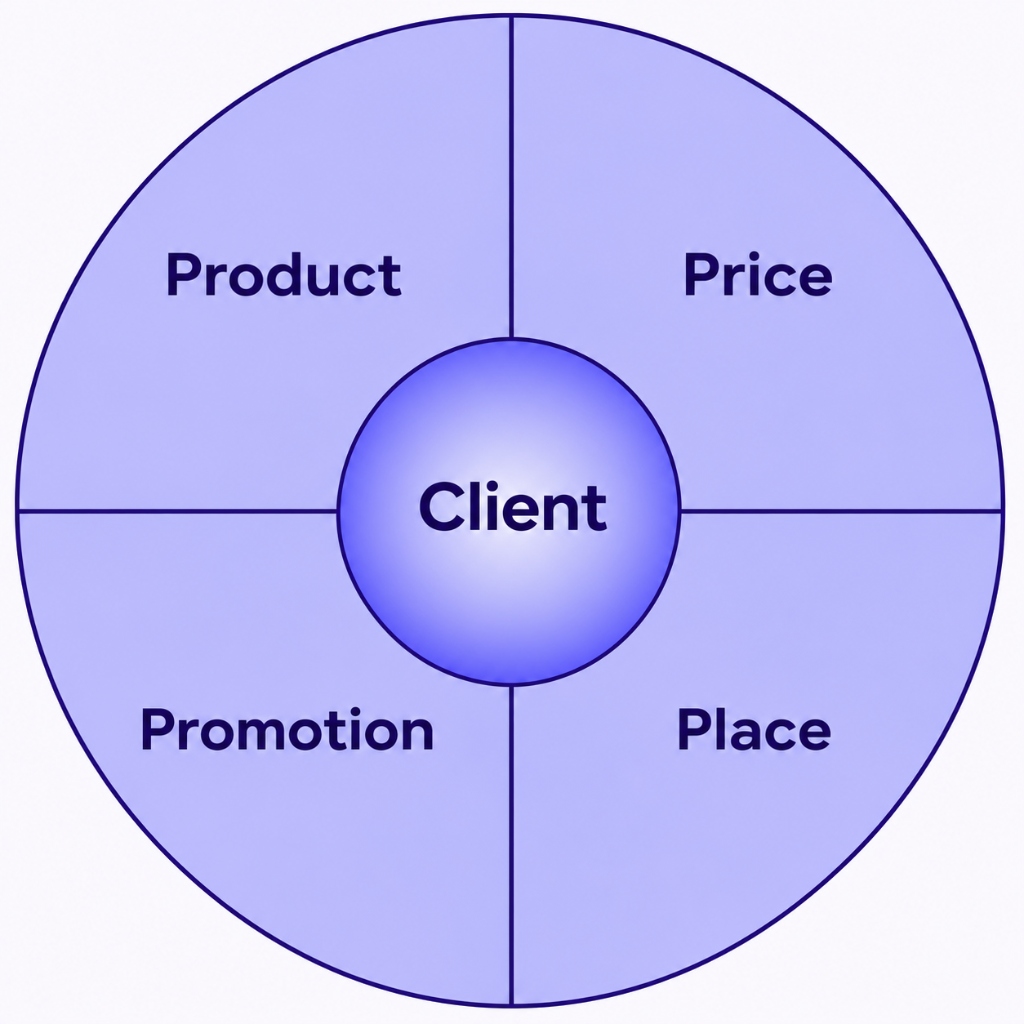 Customer-Centric Marketing Mix: Product, Price, Place, and Promotion centered on the Client
The fundamental difference between digital marketing and traditional marketing lies in data granularity, attribution precision, and customer centricity. In traditional marketing (print, billboard, broadcast television), measuring exact audience engagement before purchase is difficult, and campaign adjustments require weeks of production lead time.
In contrast, digital marketing centers the classic marketing mix—Product, Price, Place, and Promotion—directly around the digital Client experience through real-time behavioral telemetry:
- Real-Time Funnel Visibility: Web analytics suites (such as Google Analytics and HubSpot) allow marketers to track unique visitor counts, average session durations, scroll depths, and conversion drop-offs instantaneously.
- Precise Multi-Touch Attribution: Tracking parameters and UTM tags identify the exact acquisition channel (organic search, referral link, paid ad, or social campaign) that drove each user signup.
- Dynamic Budget Reallocation: If organic search generates 40% of high-LTV customers while display ads underperform, marketing spend can be shifted programmatically within minutes.
- Behavioral Journey Mapping: Marketers can analyze user behavior patterns across multiple touchpoints before a transaction is completed, enabling targeted retargeting and automated lead nurturing.
Digital Marketing Acquisition Channels & Analytics Matrix
| Acquisition Channel | Customer Intent Level | Target Funnel Stage | Core Conversion Metric | Primary Analytics Tool |
|---|---|---|---|---|
| Organic Search (SEO) | High (Informational & Commercial) | Top & Middle of Funnel (Discovery) | Organic traffic growth, keyword ranking, CTR | Google Search Console, Ahrefs |
| Paid Search (PPC) | Very High (Transactional) | Bottom of Funnel (Conversion) | Cost Per Acquisition (CPA), ROAS, Conversion Rate | Google Ads, Bing Ads Manager |
| Social Media Ads | Medium (Awareness & Retargeting) | Full Funnel (Awareness to Retention) | Cost Per Click (CPC), Engagement Rate, CAC | Meta Ads Manager, LinkedIn Campaign Manager |
| Email Marketing | High (Existing Subscribers / Leads) | Retention & Expansion (Loyalty) | Open rate, Click-to-Open (CTOR), Unsubscribe Rate | Customer.io, Klaviyo, HubSpot |
| Content Marketing | Moderate to High (Educational) | Consideration & Evaluation | Time on page, Lead form submissions, Downloads | Mixpanel, Google Analytics 4 |
Types of digital marketing
As hundreds of millions of consumers and corporate decision-makers connect daily across web and mobile platforms, digital marketing has evolved into an essential operational pillar for modern enterprises. Organizations transition the open internet into a dynamic commercial exchange, utilizing inbound content, performance advertising, and lifecycle automation to achieve sustainable customer acquisition and revenue growth.


