
7 Basic Principles of SaaS Marketing (With Formulas, Examples, and Tips)

7 Basic Principles of SaaS Marketing (With Formulas, Examples, and Tips)
Software-as-a-Service startups have become a staple of the new cloud-based economy. There are estimated 10.000 private SaaS companies and 50 publicly traded giants with a combined market capitalization of over 225 billion dollars.
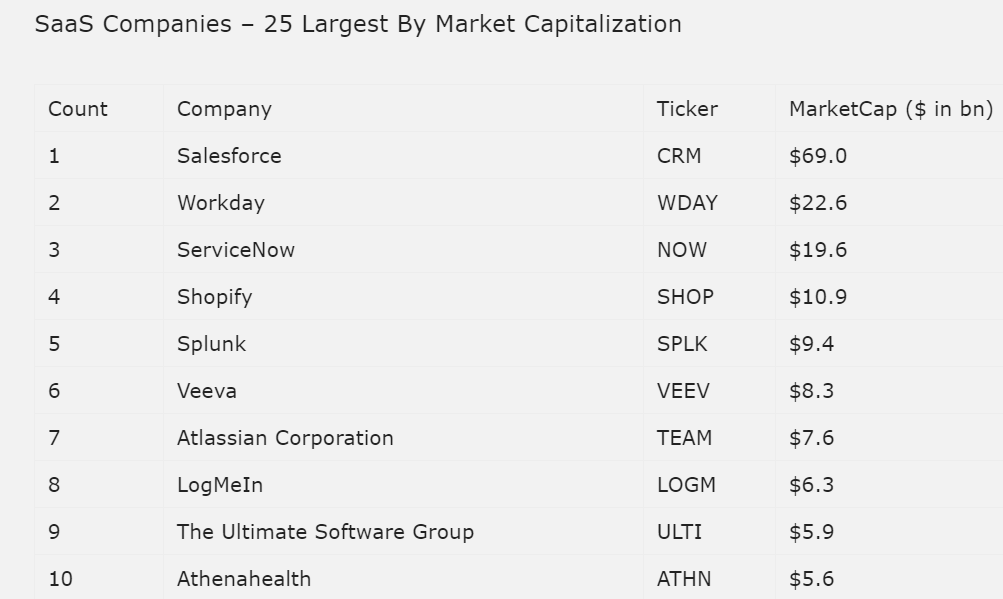 The 10 largest SaaS companies
And what do these companies have in common? They use what is commonly referred to as SaaS marketing.
But what is SaaS marketing? What do you need to measure to be successful and which channels are better than others for selling a SaaS product?
Let’s try to answer these questions (and more) with this blog post. Ready? Let's get started!
Table of Contents
- What is SaaS Marketing?
- SaaS Marketing Terminology Explained
- How to Define Metrics in SaaS Marketing
- The Role of Free Trials in SaaS Marketing
- Top Channels for SaaS Marketing
- A low niche before targeting the mass market
- Always track conversions and measure ROI
What is SaaS Marketing?
SaaS marketing refers to the unique set of activities, tactics and strategies implemented to position and sell subscription products to new customers.
You can think of SaaS marketing as the art of ensuring that your SaaS product is relevant and able to address the needs of your target customers in a way that compels potential customers to learn more about, try out, and ultimately subscribe to your product over the multitude of competitors.
We'll see how SaaS companies attract customers later, but first let's clarify an important aspect of SaaS marketing: terminology.
As with any specific marketing category, SaaS marketing also has some technical terms that you should become more familiar with, such as CAC, LTV, Churn, and NPS, to better understand the concept behind this type of marketing.
SaaS marketing terminology explained
There are a few terms that are most commonly used when discussing SaaS marketing. We have compiled a list of them here and explained each one.
Customer Acquisition Cost (CAC)
Simply put, customer acquisition cost is the amount in EUR it costs you to acquire a new paying customer on a specific marketing channel. For example, if you spend 1.000 EUR on Google Ads and get 10 paying customers, your CAC is 100 EUR.
Formula: All marketing channel spend / number of paying customers resulting from it.
For organic channels like content marketing, organic search, or organic social, it can be complicated to accurately measure CAC.
Customer Lifetime Value (CLV, CLTV or LTV)
Customer lifetime value is basically the value that a single paying customer brings to your business on average. If you only sell one subscription at a price of 30 EUR/month and your customer stays for an average of 6 months, your CLV is 180 EUR.
If you have multiple subscription prices, the calculation becomes a little more complicated.
Formula: Average Subscription Price * Average Customer Lifetime (Duration of Subscription) / Number of Customers.
CLV:CAC Ratio
The CLV:CAC ratio is simply the ratio at which the customer lifetime value is greater than your customer acquisition cost. If it costs you 60 EUR to generate a customer and each customer is worth 180 EUR on average, your CLV:CAC ratio is 3.
Formula: CAC / CLV
Customer Churn Rate
Churn rate is the percentage of paying customers who cancel their subscription during any period. For example, a weekly churn rate is significantly different than a quarterly churn rate.
To calculate the churn rate, simply choose a specific time period and calculate the percentage of users who canceled the subscription. If 100 of 10.000 customers left in a month, the monthly churn rate is 1%.
If you want to calculate churn rate separately from growth, you must exclude newly acquired customers from the totals when calculating.
Formula: Users who left in X period / Sum of existing users X 100
Net Promoter Score
The Net Promoter Survey is a widely used survey that many startups and SaaS companies use to assess a user's likelihood of promoting their product.
It is a simple one-question survey that asks the customer to estimate the likelihood of recommending the product to others.
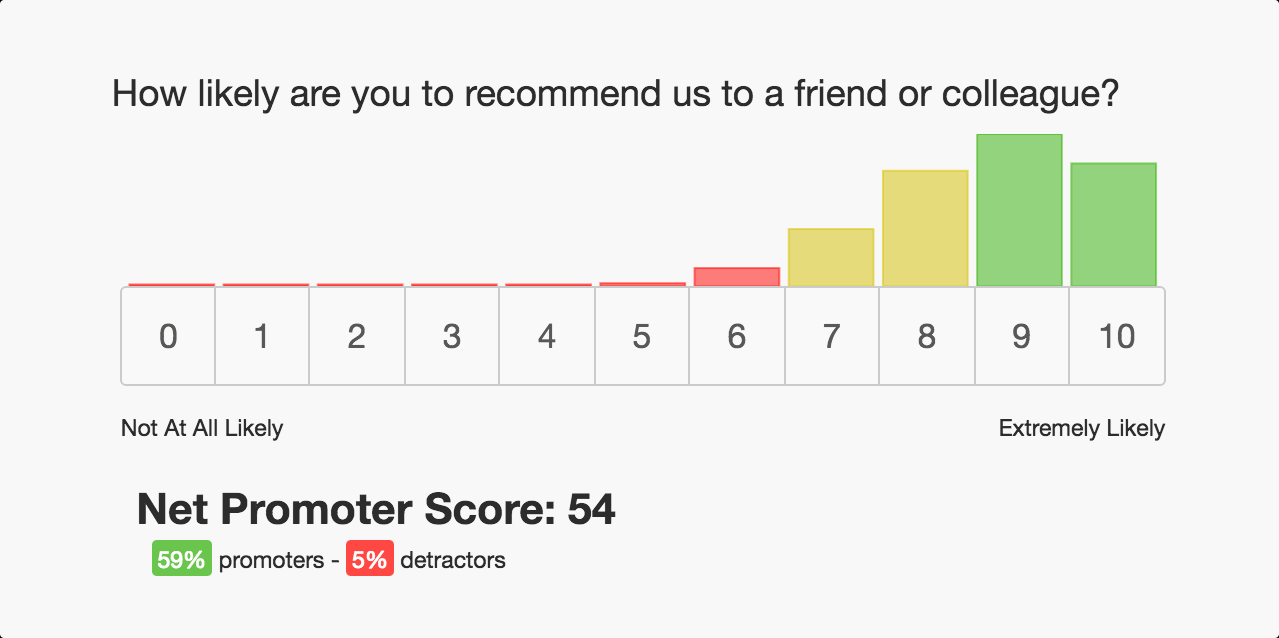 net promoter score
Promoters
Any customer who leaves a score of 9 or 10 is considered a promoter. Users like these are likely to share positive information about your product or service.
Detractors
Any customer who leaves a score of 1-6 will be considered a slanderer. A backbiter is someone who is likely to share negative information about your company.
Neutrals
Anyone who chooses a 7 or 8 is considered neutral. These customers are happy with your product, but are unlikely to share information about your service, whether negative or positive.
Net Promoter Score (NPS) Calculation
Let's look at an example. You ask 100 customers to take the survey, and all 100 customers answer the survey. 15 customers respond from 1-6, 30 people respond from 7-8, and 55 people respond from 9-10.
These results mean adding 55 supporters, subtracting 15 detractors, and 30 neutral ones, which you don't count.
55-15 = 40, which means the NPS is 40 in this case.
Formula: %Promoter – %Detractor
Customer onboarding
The term “customer onboarding” refers to the process of getting users who have signed up for a free trial to start using the service and eventually become a paying customer. The more someone uses your service, the more likely they are to become a paying customer at the end of the trial period.
And the more a paying customer relies on your product, the more likely they are to remain a paying customer for the foreseeable future.
Monthly Recurring Revenue (MRR)
Monthly Recurring Revenue is simply the total amount of contributions paid by the total number of paying customers per month. Make sure you don't include flat rates for annual/quarterly subscriptions during this month. You should also make sure that you exclude one-off payments.
How to define metrics in SaaS marketing
When you market a SaaS product as opposed to a one-time sale, you are investing in the future of each customer relationship. This is the difference between SaaS marketing and consumer product marketing.
Sales potential typically means using the customer lifetime value rather than the first interaction value to calculate marketing ROI. These metrics help plan the budget for the channels you want to spend on.
For a typical ecommerce store, it would be enough to have ecommerce conversions tracking the value of each sale.
Then all you have to do is check the campaign breakdown in Google Analytics to see how the campaigns are performing.
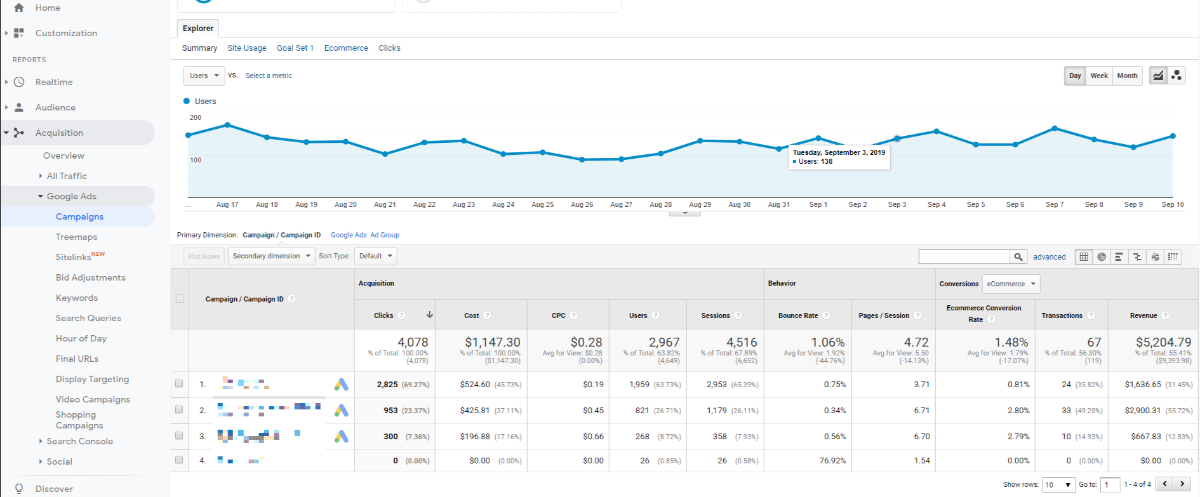 Google Analytics Dashboard
But with a SaaS business, there are a few more hoops to jump through. If you use a freemium strategy, you need to know the conversion rate from trial users to paying customers. And you need to know the average customer lifetime value.
Then you have to set up different conversion points for free trials and actual sign-ups from paying customers.
How to measure/project the effectiveness of marketing spend for SaaS companies
If the average customer value is 180 EUR and 20% convert to paying customers, a new test user is worth 36 EUR on average.
Formula: Average Customer Lifetime Value
Based on the present example, one can afford to invest up to EUR 35,99 for each test user to convince them to become a paying customer and still make a profit. So, at this point, a Google conversion goal for test users worth 36 dollars can be set.
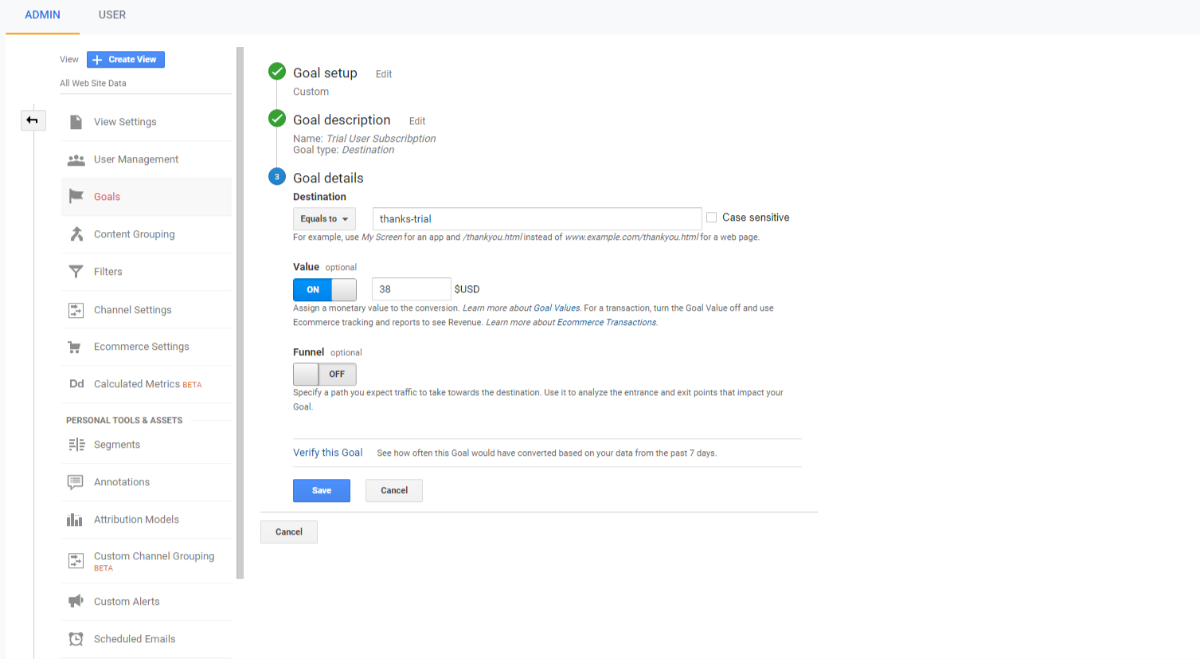 Setting Google Analytics goals
This metric will give you insight into whether or not a campaign will be profitable in the long term.
But this theory is not always successful as the conversion rate of CLV and test users can vary from channel to channel.
Measure channel-specific metrics
While it's essential to know the average CLV and test user conversion rates across all channels, you also need to measure each channel individually.
If you use a CRM like Salesforce, you can automatically tag your customers with the medium or channel they visited through. This can be done e.g. B. achieved with UTM parameters.
Additionally, in the signup forms, one can create separate landing pages with hidden fields indicating the channel that sent them.
Why is this important? Because you could end up wasting tens of thousands of dollars on channels that don't convert trial users into paying customers.
Dean McPherson, co-founder of Paperform, found this out the hard way. They ran Google Search Ads and converted clicks into test users for just $4 each. When they calculated ROI based on the average ratio of trial users to paying customers, it made perfect sense to move forward.
But then he ran a channel-specific review and looked at how many of the test users Google Ads generated had converted.
The answer was shocking. A big fat zero test user group that the SaaS gained through paid Google ads ended up converting.
Following this discovery, they immediately shut down their Google Ads campaigns.
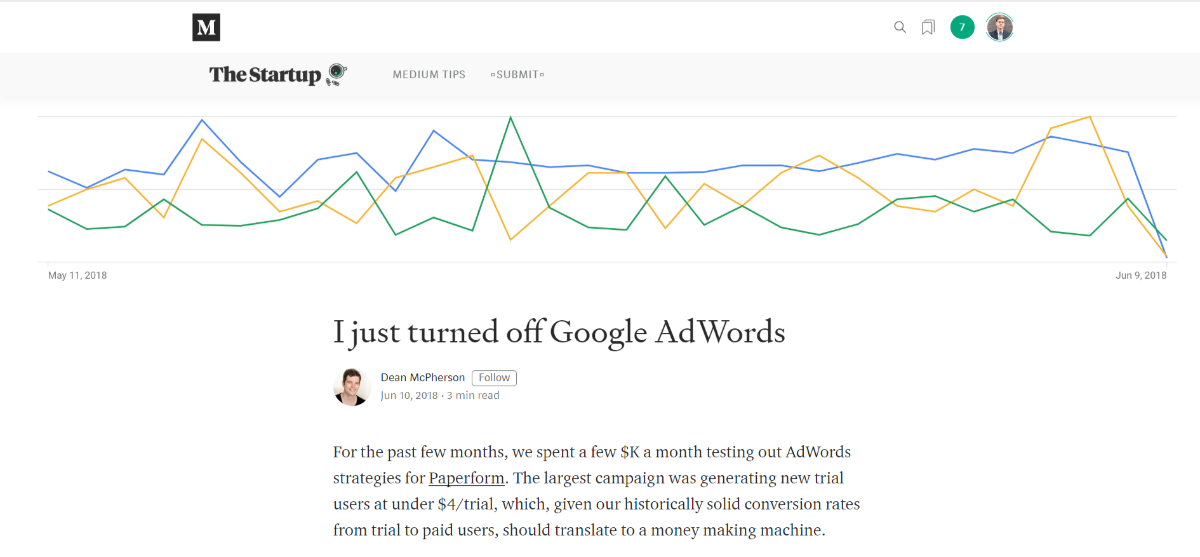 Paperform has turned off AdWords
This SaaS horror story is the perfect example of why you need to measure CLTV and test user conversion rates for each individual channel.
Otherwise, you don't know what influence each individual channel has on the final result.
The Role of Free Trials in SaaS Marketing
You can't talk about SaaS marketing without mentioning the role of the freemium or free trial model.
Almost every major SaaS company offers a free trial of their product.
 Salesforce offers free trials
The fact is that it is much easier to convert “cold” traffic with a free offer. Any SaaS company that offers a free trial is betting that it's worth the extra hassle of registering duds. Or they have done split tests in the past and know for sure that they make more money with free tests.
The best-selling tool/argument for a growing SaaS solution has to be the product itself. This is why free trials can be so useful.
It's one thing to hear a representative say, "Our product is much better than option A, you won't have problems like XYZ anymore if you make the switch." It's a completely different thing to use the software and feel the difference yourself.
But that doesn't mean free trials have to be the foundation of your go-to-market strategy. Other successful SaaS companies run weekly/monthly paid trials at a discounted rate. Ahrefs, one of the most successful SEO SaaS companies on the internet, offers a one-week trial for 7 EUR.
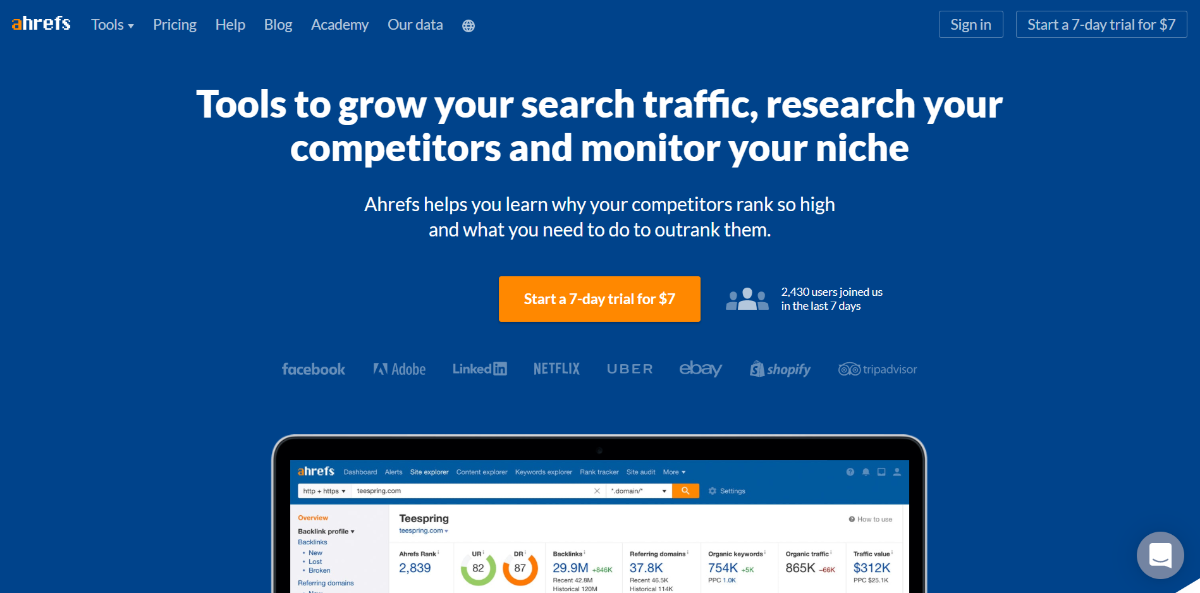 Ahrefs.com
Free trials are not necessarily the only business model to be able to determine and win with SaaS marketing tactics.
Only by experimenting and testing can you find out what works best for the company.
Top channels for SaaS marketing
The key to a successful SaaS marketing campaign is not to include the channels/platforms and Social Media Posts copying the competitor. It is necessary to develop a culture of measurement, idea finding and experimentation. Which channels are suitable for your own company depends on the target group and the skills of the founder team.
Below we have listed a list of channels that can be scaled for emerging startups. We did not focus on the paid acquisition/SEM, as the channels are usually not scalable for SaaS companies in the early phase.
For example, the general keyword ‘CRM’ costs up to the time of writing this article 12,72 Dollar for a single click. This means that you have more than every visit to your landing page 13 To generate dollars in value.
 Google Ads bids on CRM keywords
This is not feasible for most new companies. You need an impossible conversion rate, an undamaged ratio of tests to customer and a very high LTV to try to achieve a profit at all. Large technology companies use their large budgets to buy smaller competitors.
That's why you have to look beyond the edge of the plate and focus on platforms that reward small businesses for creativity and originality.
-
Organic Search / SEO
-
Content Marketing
-
Email Marketing
-
Social Media
-
Influencer Marketing (Focus on Micro-Influencers)
Organic Search / SEO
SEO stands for search engine optimization. Essentially, the spirit of SEO is to create content tailored to people's search terms. You also need to optimize your pages and website for SEO to get organic traffic from Google and other search engines.
93% of all online experiences start with a search. As of August 2019, Google had92,37% market share of total search traffic worldwide. And 57% of B2B marketers (source unavailable) cite SEO as their biggest lead generation channel.
If your SaaS is primarily B2B, this means SEO should probably be the priority to test.
These are the basics of search engine optimization:
-
Use SEO tools to identify keywords your potential customers are likely to search for.
-
Find low competition opportunities among these keywords.
-
Create pages and articles that target relevant keywords.
-
Optimize these pages for both your target audience and search engines such as Google and its alternatives.
-
Create relevant links from high authority websites.
-
Analyze what works for your website and what doesn't.
It might sound complicated when you summarize it like that, but with the right tools, most SaaS companies will learn in no time.
Let’s dive into an example to see how powerful SEO can be for a SaaS product.
Success story: Zapier
Zapier has exploded and become the number one integration tool by implementing a simple SEO strategy at scale.
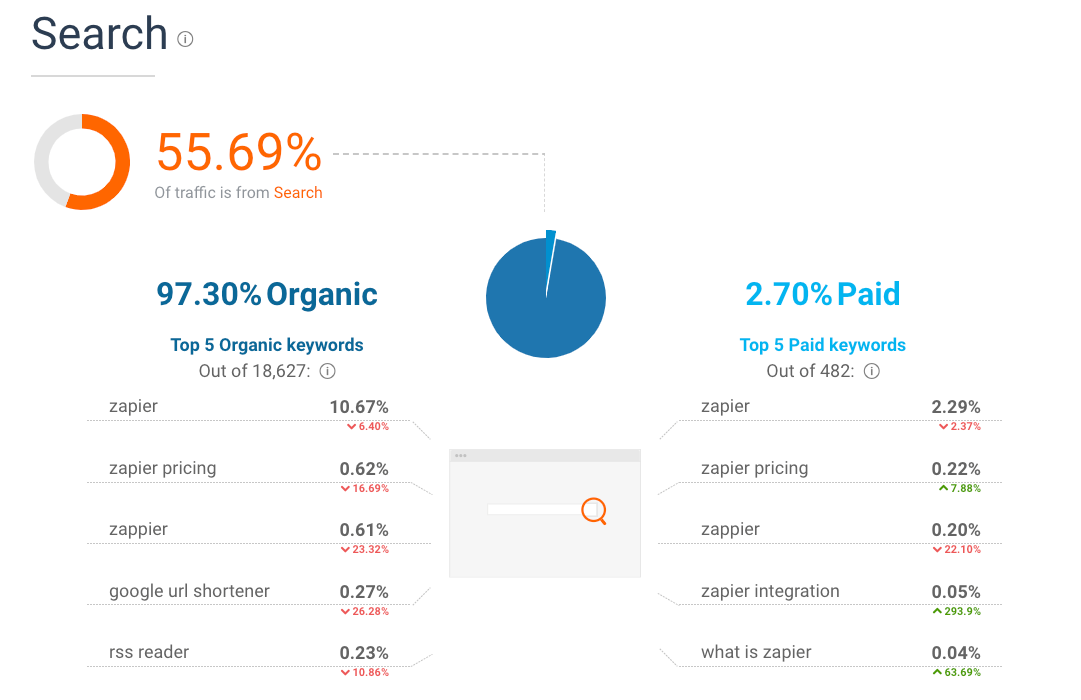
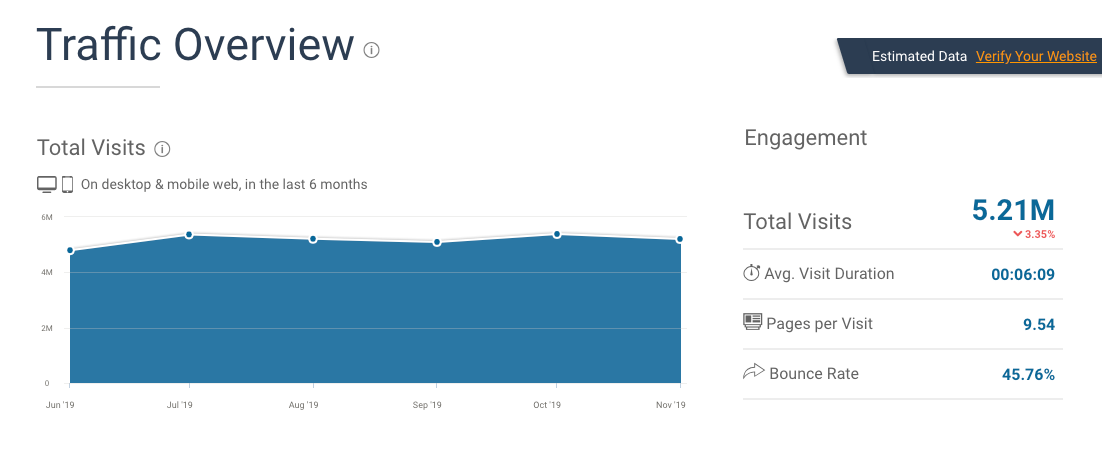 SimilarWeb report for Zapier.com
According to SimilarWeb, zapier.com receives over 5 million visits per month. And the majority of that traffic comes from organic SEO.
 SimilarWeb search report for Zapier.com
More than 56% comes from search, with +10% consisting of brand queries. Even if we remove brand searches and paid traffic, Zapier still receives many visits from organic search every month.
And let's take a look at Zapier.com, using Ahrefs:
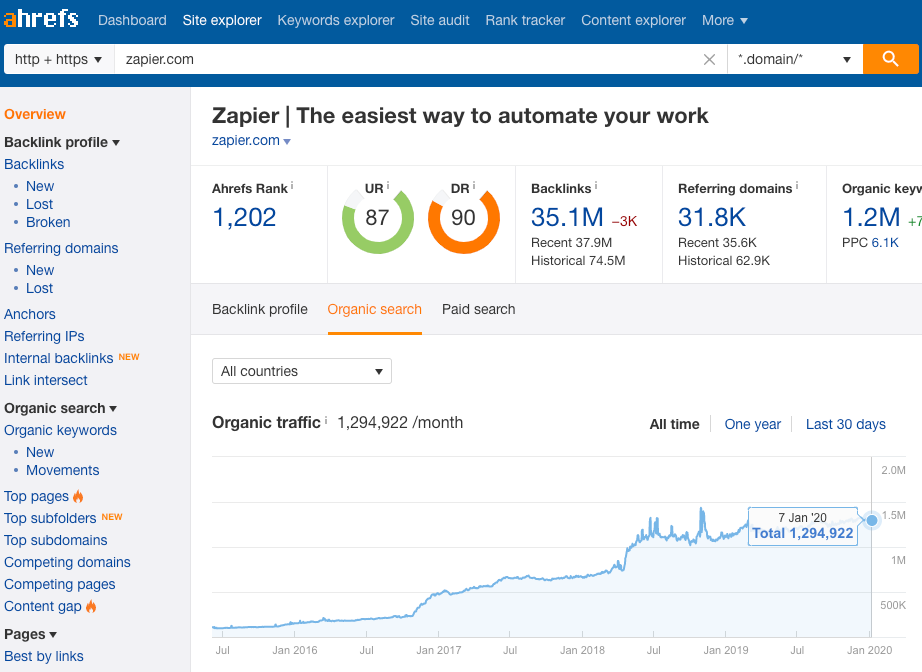 Ahrefs Report for Zapier.com
Although the visits don't match up, as different tools use different ways to track and predict these metrics, you can see how organic traffic has increased to over 1 million visits per month in the last few years.
Now, why is their strategy so effective? Because it is uncomplicated!
Zapier's marketing team targets keywords related to integrations possible with Zapier. For example “Slack Trello Integration”.
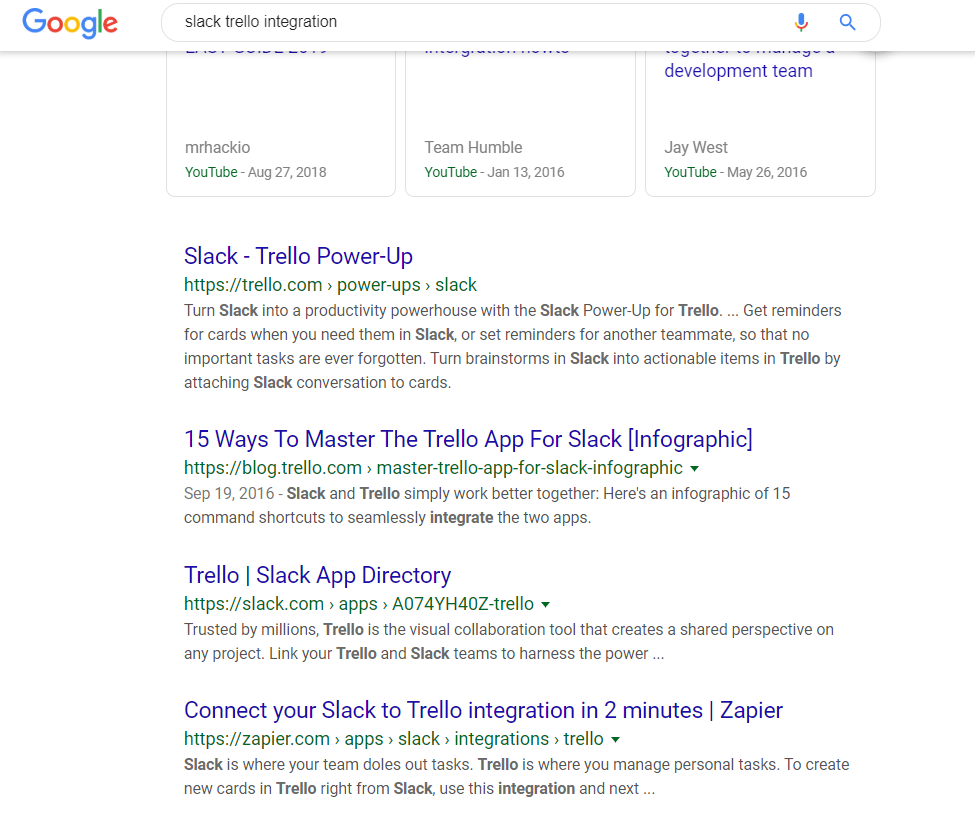 Google search results for “Slack Trello Integration”
One by one, the keywords are relatively small, but when you target thousands of different keywords, it adds up to a lot.
They also create unique landing pages that target “SaaS tool” + “integration” search terms.
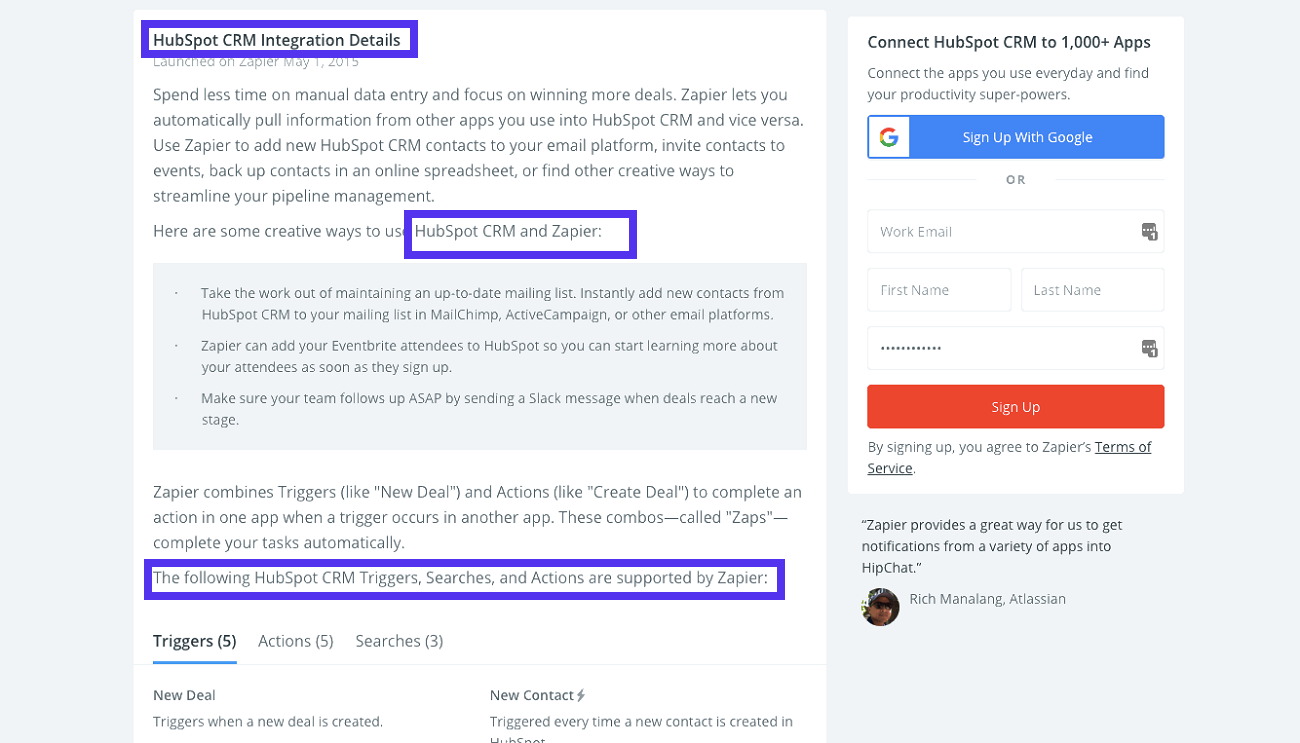 One of the many Zapier landing pages
SEO Basics: Keyword Research
The foundation of any good SEO strategy is keyword research. Keyword research is the process of finding out what specific words people use when they search for content related to your business.
While not ideal, you can start by doing some basic keyword research using free tools like Google Ads Keyword Planner. For example, if you search for “data visualization,” you’ll see a list of relevant keywords.
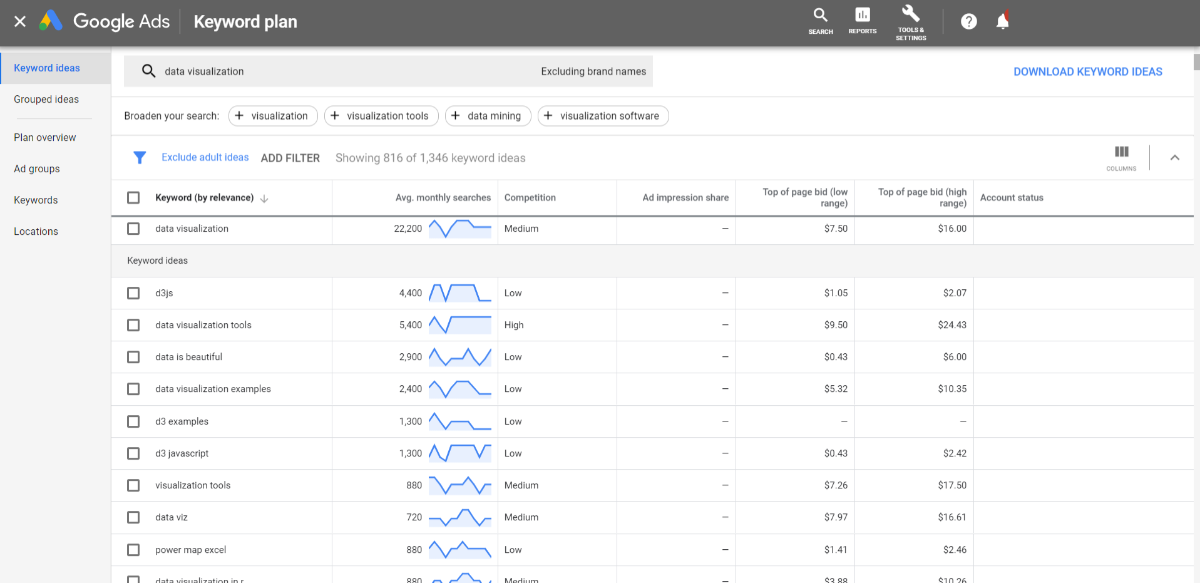 google keyword planner
It also includes metrics that can point you in the right direction. Search volume tells you how many people search for the term per month. Competition indicates how many other people are advertising on Google. Finally, the bids at the top of the page show how much a company is willing to pay for the search term.
High competition and top-of-page bids are generally an indicator of high commercial intent. Commercial intent means the searcher has the intent to purchase a solution.
So ideally, you should target keywords with reasonable volume and high perceived commercial value. However, there is no way to know which of these keywords will rank on Google.
The competition metrics in Keyword Planner only show how many companies are bidding for each keyword. For further insights related to SEO, an advanced keyword research tool must be used.
To learn more about keyword research and advanced keyword research tools like SEMRush, Ahrefs and similar, read our keyword research guide.
SEO Basics: On-Page SEO
It is in Google's best interest to provide a user with the highest quality results for every search. This way they ensure that users return to Google when they search for something.
Therefore, Google tries to provide high quality, fresh content from safe, well-organized and fast loading websiten. This is the essence of On-Page SEO.
Google has a tool to help you with this: The Google Search Console.
Check for errors in the coverage and sitemaps.
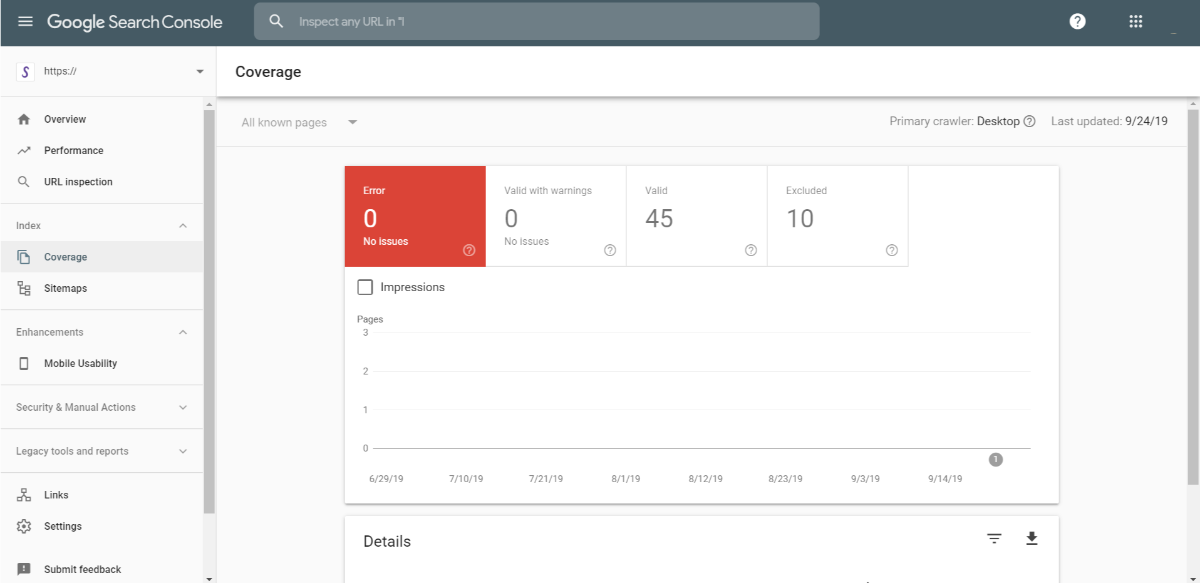 google search console
This covers the absolute basics of making sure you don't have any glaring SEO errors on your pages.
Third-party tools can be very useful here too. But if we tried to cover all the basics of on-page SEO, it would become its own post.
Luckily, we have already created a a comprehensive SEO checklist that helped us increase our organic traffic by 245%.
Marketing content
On average, customers engage with 11,4 content before conversion. And 70% of customers prefer to get to know a company through articles rather than ads.
Content marketing is an approach that focuses on creating and distributing high-quality content across a variety of channels. Successful SaaS companies have done it since their early days.
Content marketing works best when you develop a strategy that spans multiple formats:
-
Blog entries.
-
White Papers.
-
Reports.
-
Infographics.
-
Video.
By creating a reliable resource for your target audience, you can build a following. Each piece of content can be the start of a relationship with possible and potential customers.
To be successful with content marketing, you need a content distribution strategy and a voice that your audience can relate to. Be sure to check out our detailed Content Marketing Guide.
Our approach
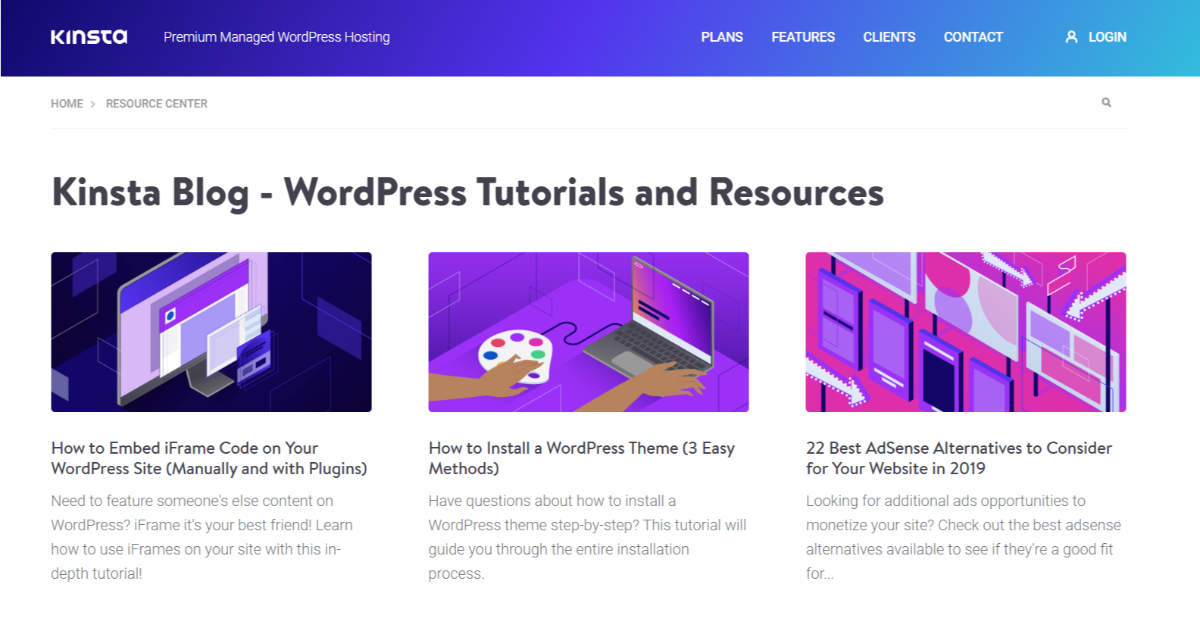 SaaS Resource Blog Example
This article and our own company blog are an example of a SaaS company investing in content marketing. We focus on delivering high quality content that is immediately useful to our target market.
We rely heavily on SEO as our primary acquisition channel, and the writing process for every new article always begins with keyword research.
In terms of advertising, we focus on building an email list to which we send our monthly newsletter, and our social media accounts to distribute our content.
Content Marketing Strategy
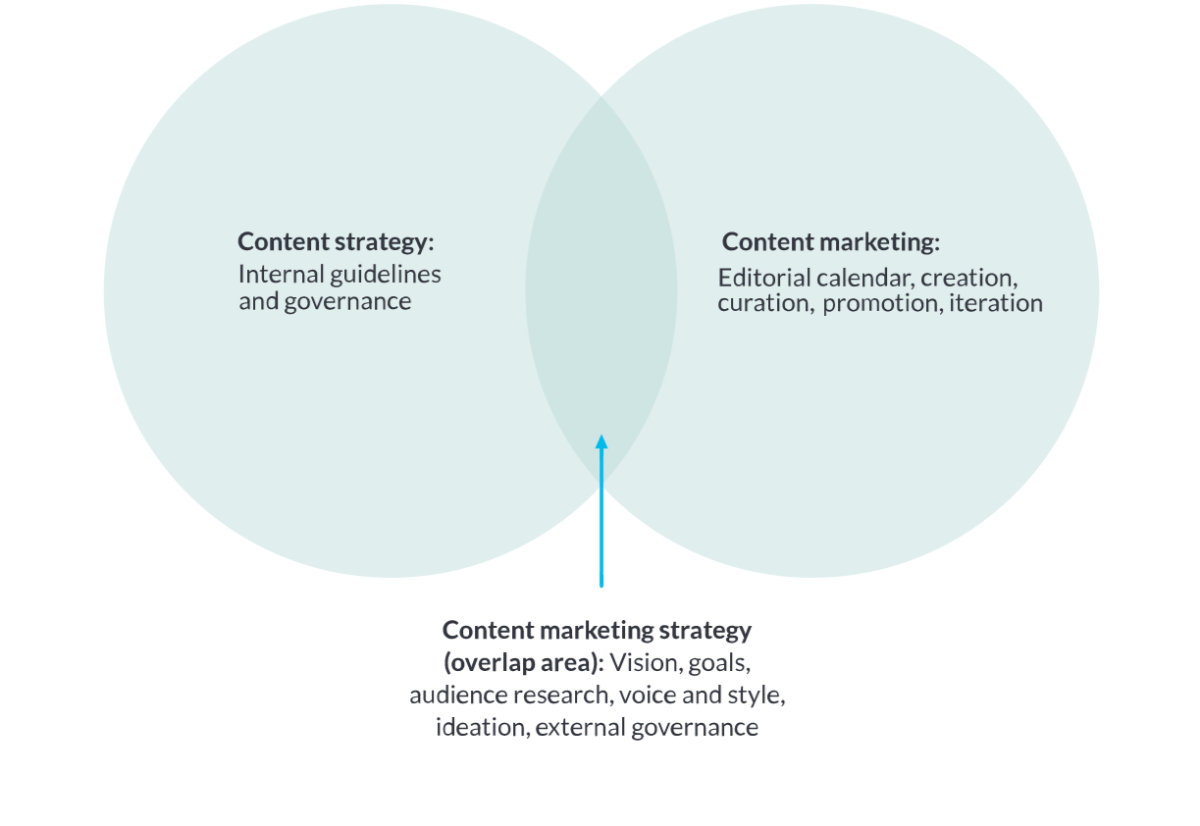 The difference between content strategy and content marketing
Many people confuse content strategy with content marketing. As Moz explains:
The content strategy deals with the vision - i.e. with the question of how and why the content is created, managed and ultimately archived or updated.
Content marketing focuses on tactics and execution – the actual creation, curation and editing of content created specifically for marketing purposes.
The overall strategy includes audience, distribution, positioning, tone, and more.
For example, let's imagine that the target group is older developers in their mid-40s. To do this, you might consider sales channels like Stack Overflow, development-focused niche Facebook groups, and SEO. You could position yourself as an “expert colleague” who tackles complex topics that interest him using technical jargon and developer memos.
All of this will change when you target junior sales reps in their 20s or stay-at-home moms.
Content Marketing Tactics
Then there are the specific tactics of exactly what content you should produce. The majority of marketers primarily engage in blogging, visual content (infographics, etc.), and videos.
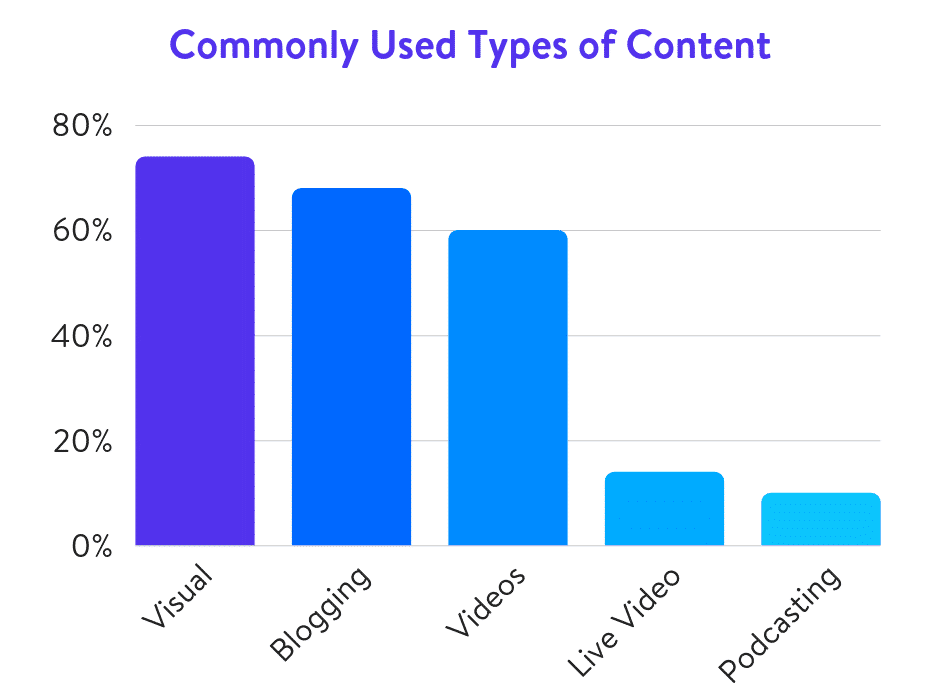 Frequently used types of content
Which medium you should choose for your company depends on your target audience and your available talent/budget.
Even if your ideal customers prefer high-quality explanation videos, it can be that this is not in your budget.
Other tactical decisions include where and how you Apply your content and how you can segment and diversify them.
Email Marketing
It is cheaper to communicate with people and build relationships with people who are already interested in your product as foreigners to convert. For this reason, email marketing can be a high ROI of 42 EUR per spent EUR record. This is completely unusual for paid acquisition of any kind.
Consequently, 59 % of B2B-Marketing specialists Email marketing as their most effective channel.
The essence of email marketing is:
-
Create a Landing Page or Registration form to collect leads with a “lead magnet” or a newsletter.
-
develop a strategy to promote traffic to this landing page or registration form.
-
E-mails to write and send help build confidence and position you as an expert in the eyes of your subscribers.
-
Expanded: Send automated, personalized emails based on user interaction with your website.
The great thing about the email is that it is the most effective channel for lead generation, but it is not too complicated or difficult to start.
A simple approach such as a weekly newsletter or an automated email Drip campaign allows you to convert a lead to a customer.
Once you have built up an audience, you can rely on marketing automation tools to segment your list and automatically send personalized emails.
It doesn’t have to be complicated: Newsletters still work
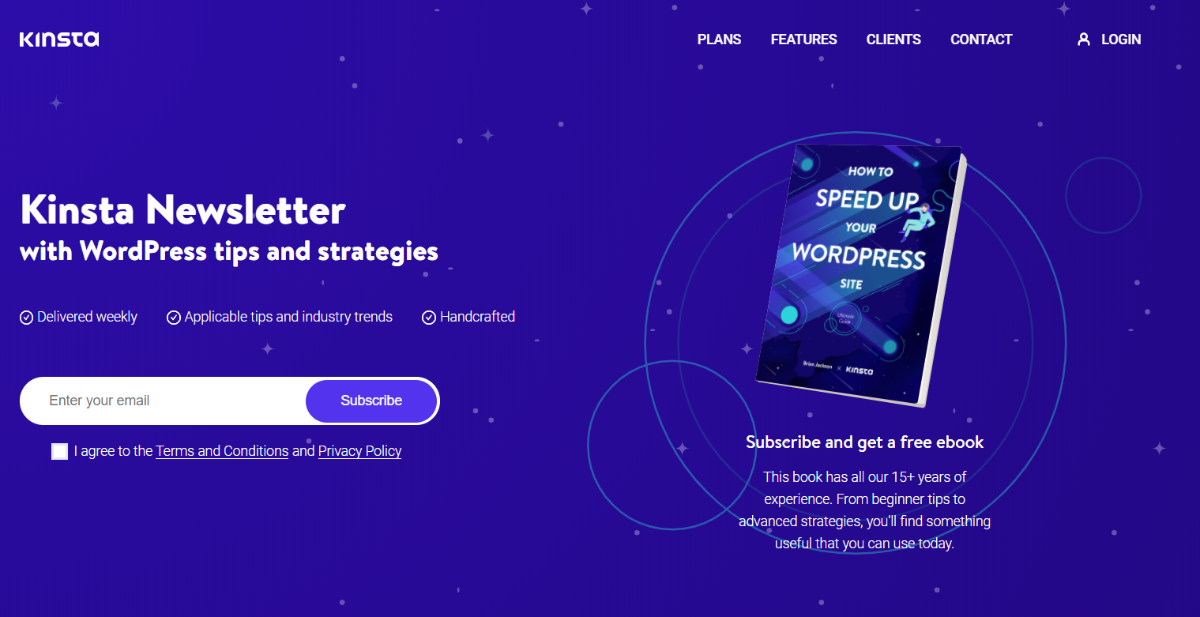 Email Newsletter Landing Page Example
Email marketing has a great synergy with other marketing channels. It helps you stay in touch with people who visit your website via Google or social media and are not willing to buy something. But don't think you have one 20- need to write part email series on a topic.
Newsletters still work.
By offering real added value in advance and over time, we build a relationship with the blog readers. Each Subscriber receives our detailed eBook that shows him, how he can speed up his WordPress site.
Since they are interested in tips on WordPress and the acceleration of their website, we already know that they are in our target market. Through the subscription, they have identified themselves as the owner of WordPress sites to which the Performance is important.
Therefore, we treat each potential customer with respect and try to provide him with added value first, instead of bombing him with automated sales emails.
If you want to prove that newsletters are still working, check out The Hustle, a technically oriented email newsletter that is recent 1 Million subscribers has won.
Autoresponders
Autoresponders or automation tools are cloud-based SaaS applications that help you automate your emails to your customers and interested parties. Imagine you would have to send the welcome e-book manually every time someone sign up for your newsletter.
That would be a hundred hours of work every year. That wouldn't be an effective use of your time.
This is where autoresponders come into play.
For example, someone sign up for our newsletter, the form automatically sends the data to the autoresponder. Then he will receive a greeting email like this within seconds.
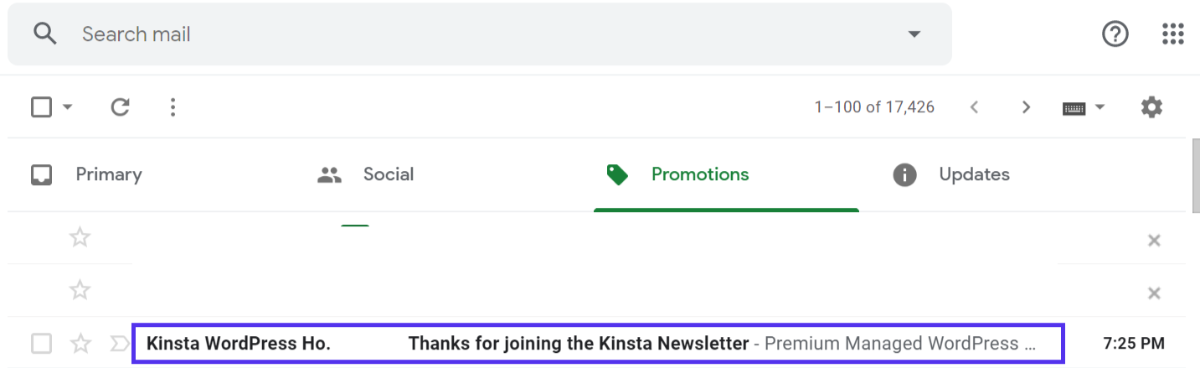 Automated Welcome Email Example
With the help of autoresponders, automatic emails can be sent in response to different user behavior on the website.
Perhaps the most important is the automatic tracking of persons who have gone after half of the ordering process.
If you want to learn how to control Autoresponder, read our Guide to using Mailchimpto start.
Email list segmentation
If you use the segmentation of the email list, your automated emails will be personalized and relevant. In this way, your potential customers see news that are important to them at this moment. This approach brings 26% higher opening rate as in mass e-mails.
You can easily create separate lists for subscribers who have visited your blog last week or have registered for a free trial version. In addition, special lists for different categories of paid users can be created so that they are excluded from all advertising mailings that would be irrelevant to them.
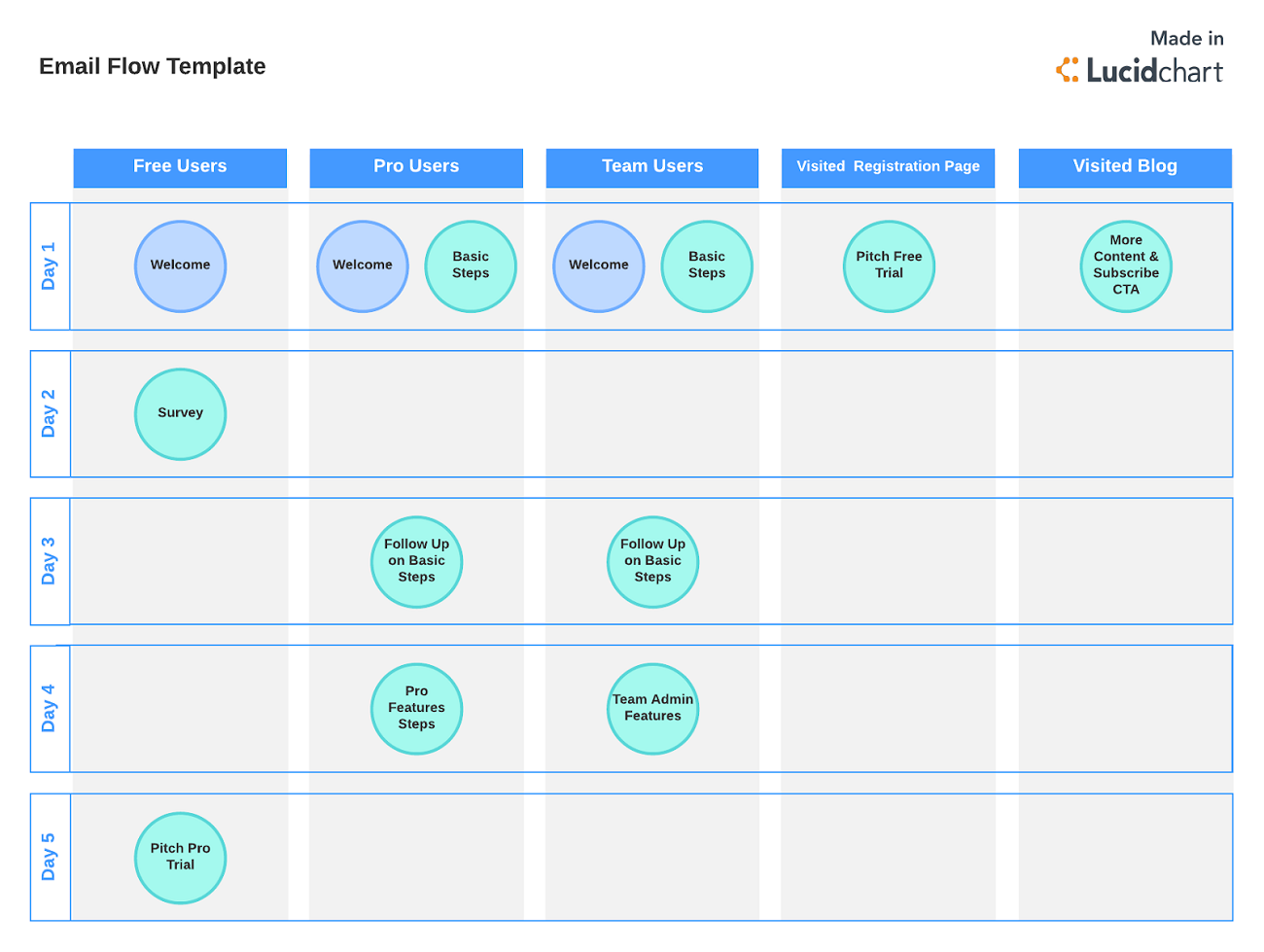 Email Segmentation Example
The above Example shows how such a flow could look on the paper.
Social media
Through a varied approach of organic contributions and paid ads see many SaaS companies success through marketing on social media platforms.
Social media marketing uses a mix of organic postings and paid ads to build a fan community on one of the following social media platforms:
-
Instagram.
-
Facebook.
-
LinkedIn.
-
Twitter.
-
YouTube.
There are more than 4,80 billions of social media users in the world. This makes social media one of the best scalable channels.
Moreover, no costs are incurred for the platform when you start. You can still set up a business Instagram page for an investment of zero EUR today.
This makes social media marketing one of the first things new SaaS companies are experimenting with.
But it takes time, effort and investment to be successful.
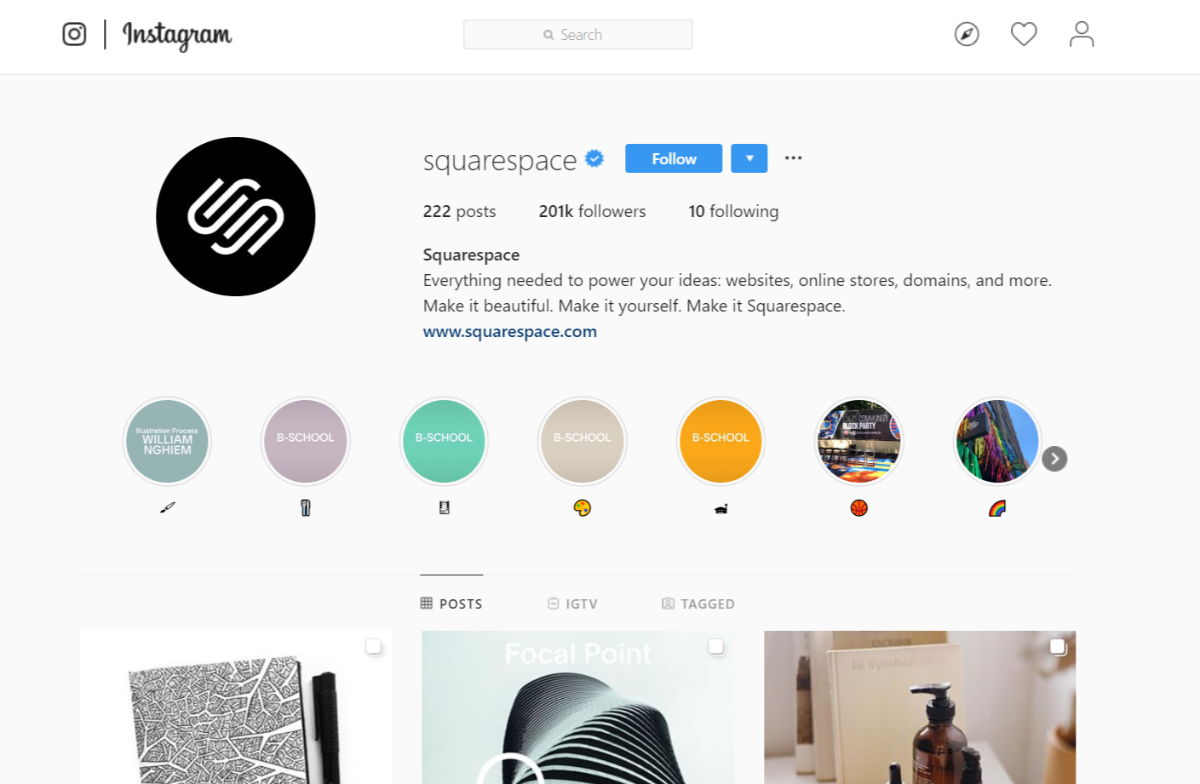 Squarespace Instagram Account
Squarespace, a website builder SaaS, has over 201.000 Followers on Instagram.
You have managed to get there with a combination of advertising, influencer marketing and non-stop output of high quality.
In its recent campaign they have joined with photographers and made some nice recordings before presenting the photographer's website. A website created with Squarespace understands itself.
 Squarespace Instagram campaign
It is not enough to just post what you have in your heart, and to hope that you attract an audience.
Learn from successful competitors
The biggest “Cheat Code “ at social media marketing is to looking under the hood of what successful competitors are doing.
If you already know such direct competitors, you're lucky. Just go on their social media pages and analyze the content.
Try to answer the following questions:
-
What types of contributions do most of the engagements have?
-
Which tone seems to be the most effective?
-
How do they position themselves?
Since a social media strategy is often integrated as part of a more comprehensive strategy for marketing content and deserves its own contribution, we will not discuss it in detail here.
But if you want to immerse yourself and get to know the peculiarities of the SMM, you can This Guide read by Hubspot.
Influencer Marketing (Focus on microinfluencers)
To be seen in social media, it is not enough to create a page and post some images. The organic range of business pages is alone Year 2016 around 52% declined and since then continuously declined.
You have to reach an audience. This is where the influencer marketing comes into play.
Influencer Marketing is a concept in which you turn to influencers and win them for advertising for its products. Typically, companies conduct influencer campaigns where they identify relevant influencers and pay them to present a particular product.
How much a single placement costs depends on the size of their fan community and how dedicated their audience is. A single Instagram post by Selena Gomez will cost you millions of euros.
This is not a practicable strategy for most emerging SaaS companies. The audience of the big influencers is too wide, so that you finally pay for a lot of uninterested views.
Micro-influencers are the most effective way to achieve this with a tight budget. The engagement rates for campaigns with micro-influencer are 60% Higher as in traditional campaigns.
So forget The Rocks, Christiano Ronaldos and Ariana Grandes in the world. Focus on small bloggers, developers who lead local development groups or meetings, etc.
 Micro Influencer Brand Impact
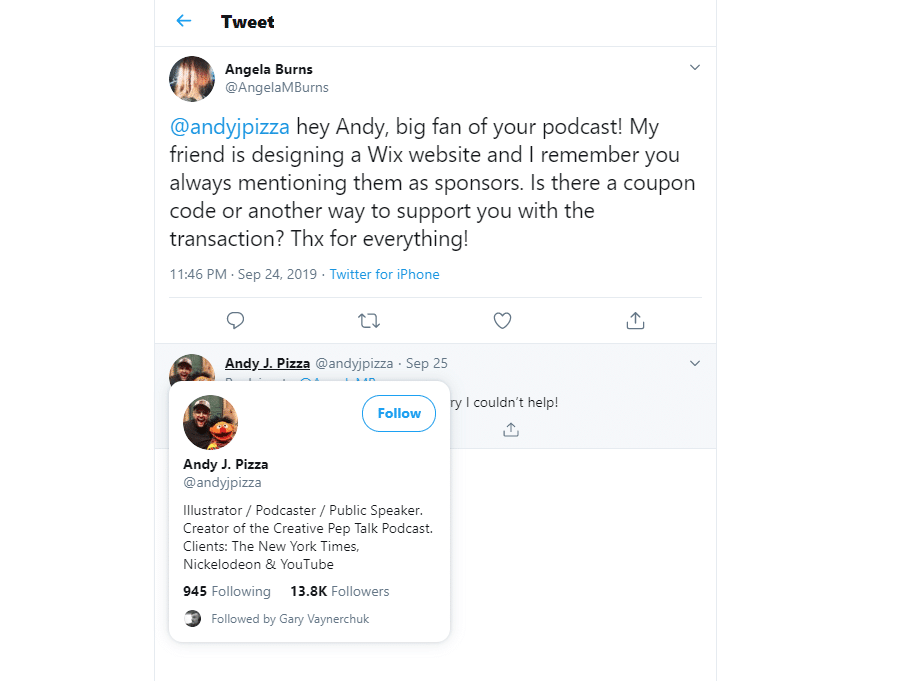
Here is a short example: Wix sponsored Andy J. Pizzaa podcaster with 13,8k Follower on Twitch (here is, starting a podcast). Just because the listeners identify so strongly with the moderator, some of them ultimately opt for Wix.
These are the kind of bonds that smaller influencers can have with their audience.
To find your influencers, you can either use the search function of the platform or use a third-party tool. An influencer tool that can be used free of charge is the Twitter influencer search of Buzzsumo.
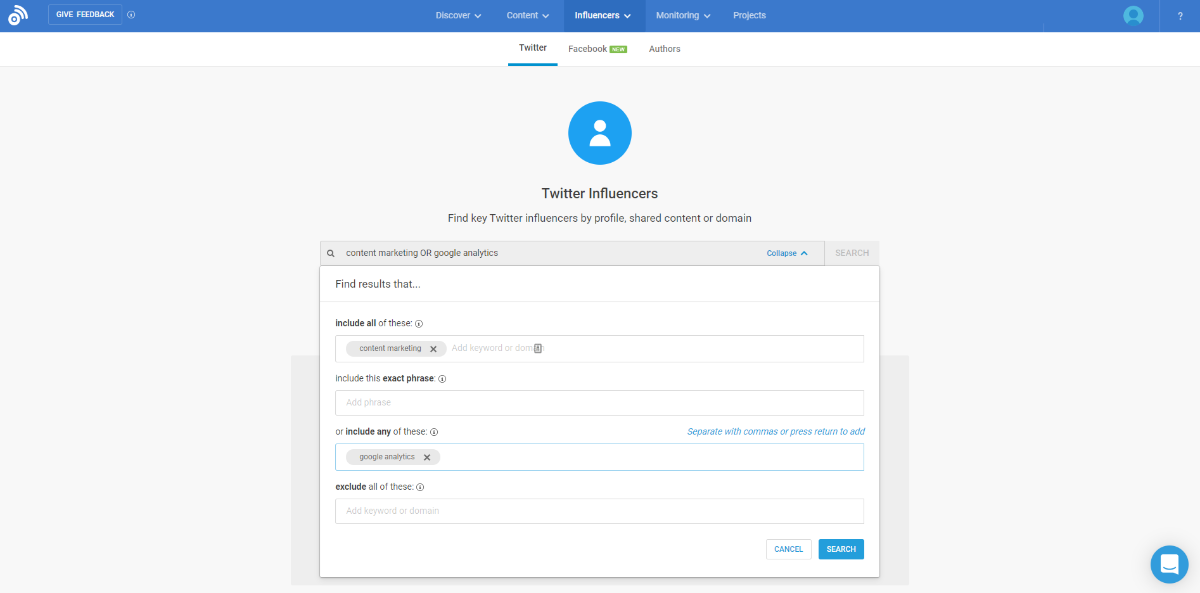 BuzzSumo Twitter Search
Let's assume that your main goal is to carry out an Instagram campaign. Simply add a filter to your search by selecting “Hat an Instagram profile”.
This filter only filters Twitter users who are also active on Instagram:
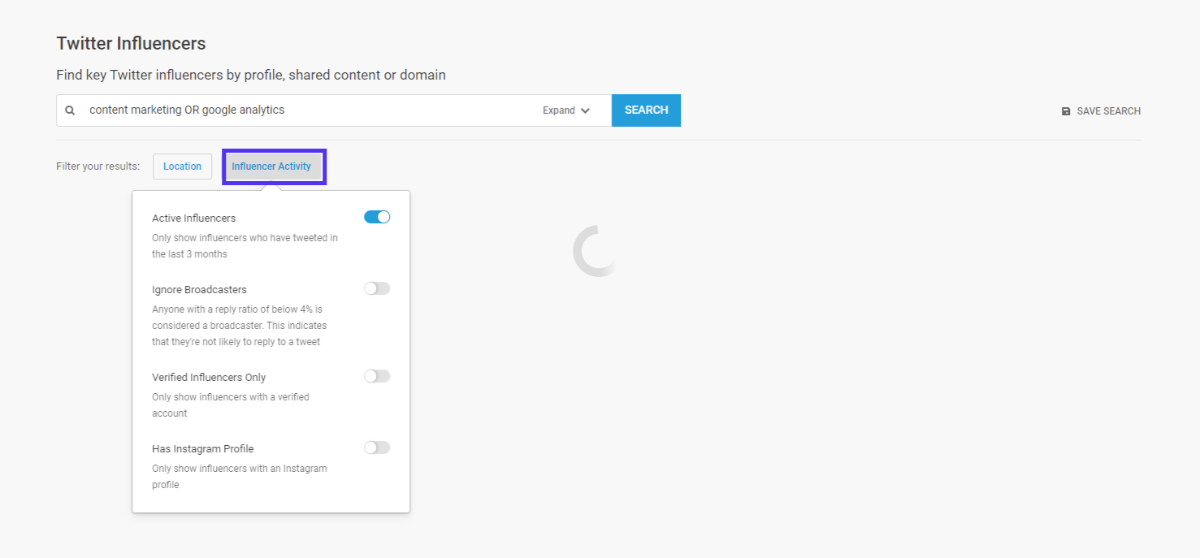 Buzzsumo Activity Filter
If you are looking, use an expression that refers to your target market. It doesn't have to be an exactly matching keyword, it can be a related concept or even a product.
If the SaaS is, for example, a data visualization plugin which is Google Analytics integrated, then you can search for the phrase “Google Analytics”.
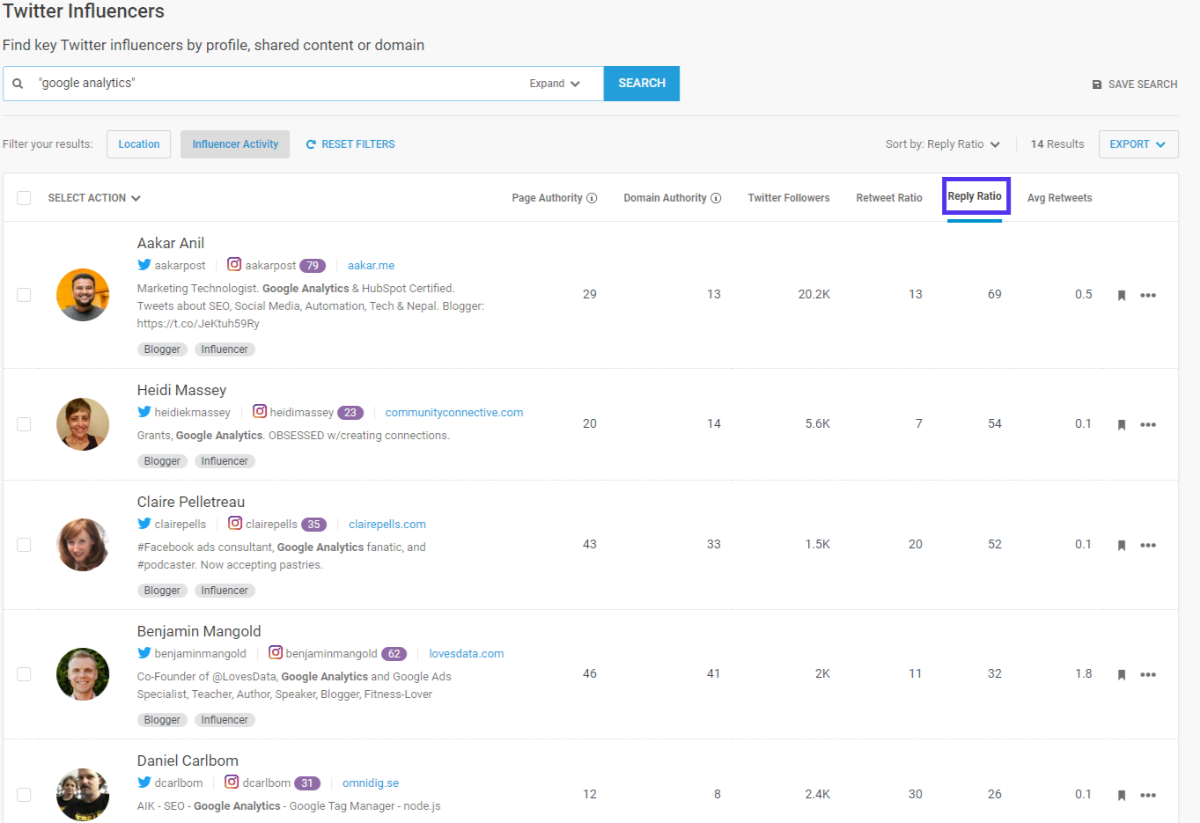 Buzzsumo Twitter influencer sorted by response rate
Once you have the results, you should sort them according to the “response rate” to see who more on yours outreach email or DM answers.
Popular Influencer Marketing Tools
Below is a list of popular marketing instruments for influencers that can be used to find influencers as well as to measure their effectiveness.
A low niche before targeting the mass market
As a technology company, it could be in your best interest to occupy a niche and specialize your product to serve a certain vertical. With a specialized service, the product stands out from horizontal SaaS competitors and gives you a marketing and sales advantage.
Instead of a disadvantage, he can make it easier to grasp in a particular industry and grow through recommendations and mouth propaganda.
Once established in a small market, you can use credibility and cash flow to align marketing efforts on larger markets.
The book “Crossing the Chasm“ by Geoffrey Moore explains this approach.
Many modern hosting providers have flourished by focusing on a specific niche like managed hosting before expanding into broader application hosting and database hosting.
Salesforce, the world's leading CRM company today, initially focused entirely on the sellers. Even your company could have better chances if you become the big fish in a smaller pond.
Always track conversions and measure ROI
There can be no successful business if you don't know what works and what doesn't. SaaS companies do not form an exception.
That's why you should be Set up conversion trackingto see which channels work better. If you have no idea, perhaps because you just started, then you should make a decision about which channels you are targeting with your available budget and resources and going on from there.
Make sure long-term organic strategies such as SEO or content marketing get a longer timeframe than micro-influencer marketing or paid acquisition.
As long as you keep an overview of the required costs and revenue generated by each channel, you can calculate your ROI. Google Analytics' standard acquisition report can be a help to keep track of the first results.
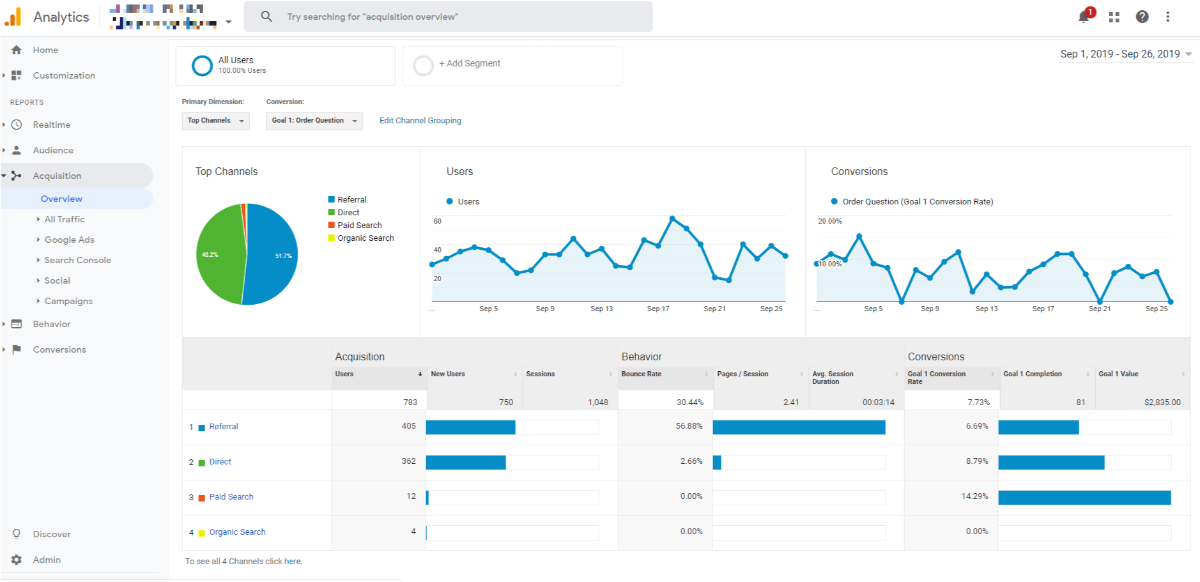 Breakdown of channels in Google Analytics
If you carry out any micro-influencer campaigns, you can also create the results by creating custom landing pages or by using UTM parameters measurement.
While CAC is a basic metric for SaaS, organic acquisition channels make things more complicated. When marketing content, it is necessary to consider things such as the wages of authors and designers, the time that the marketing manager applies to the strategy, and other overhead costs.
If you focus on SEO, you must also consider that the life cycle value of each article is likely to exceed the customers generated in the first few months by far.
Grow and Convert offers a ready-to-use table calculation model, which helps you calculate this value.
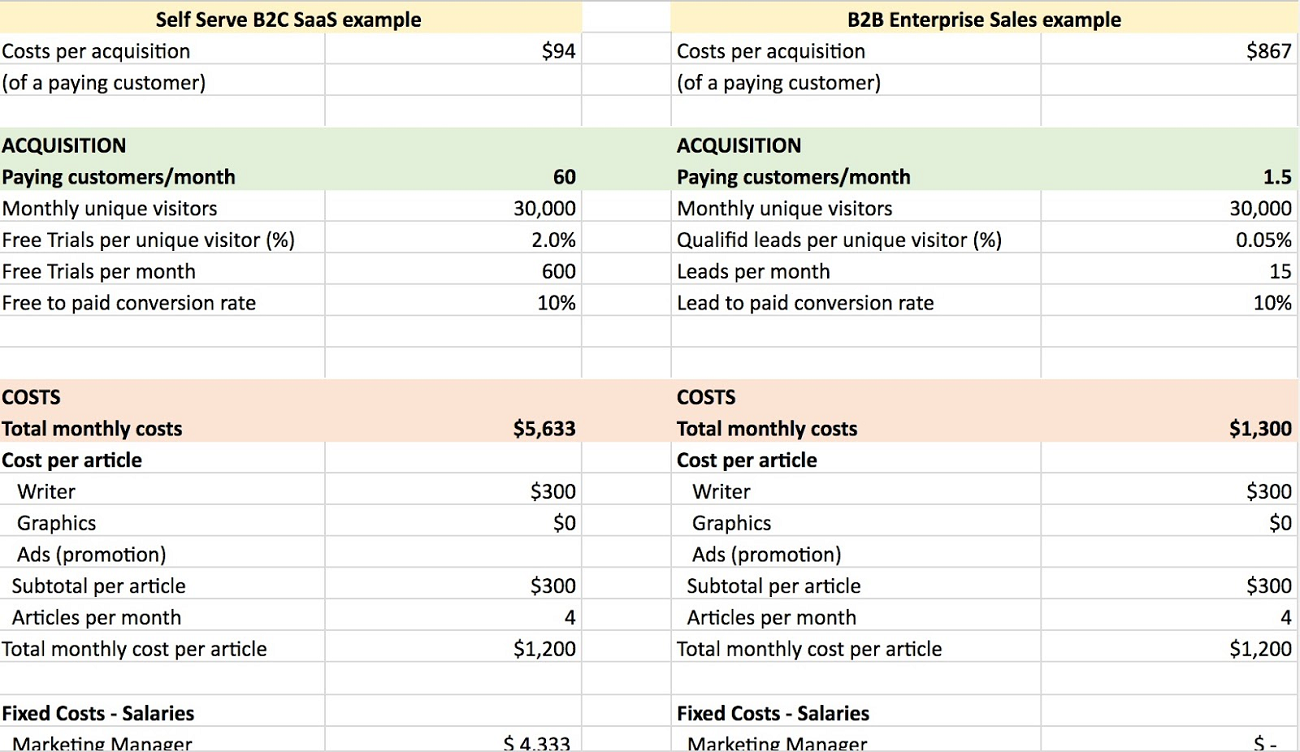 Model for calculating the CAC from content marketing
If you have all the necessary data and can calculate the CAC for each channel, you know what you should focus on.
Summary
This guide is far from exhaustive, as the world of SaaS is rather complex. However, it helps you to make your first steps to understand the basics, and shows you how important it is to find the right acquisition channels and what key indicators are to be measured.
You don't need Salesforce's budget to boost your SaaS' growth (as many bootstrapped software companies have proven). You need the right product, the right channels and the right message (your market position).
Overall, SaaS marketing does not differ so much from traditional marketing. This means that if you have discovered a specific need/painting point in a single niche for your SaaS product, you have already set a good start. And why? Because the marketing of a product that does not solve “real” problems is simply the most difficult thing to achieve.


