
Software as a Service (SaaS): business model and cloud deployment

Software as a Service (SaaS): business model and cloud deployment
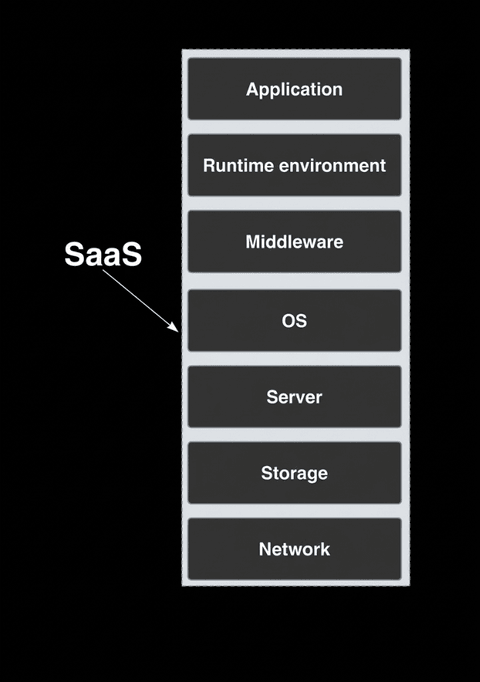 SaaS Cloud Architecture: Complete Application and Infrastructure Stack Managed by the Provider
Software as a Service (SaaS) is a software licensing and delivery model in which applications are centrally hosted on cloud infrastructure and accessed by end users over the Internet, typically via a web browser, desktop client, or API. Instead of purchasing perpetual licenses and installing software locally on physical servers, organizations subscribe to SaaS solutions on a recurring basis (monthly or annually).
In a SaaS delivery model, the cloud provider manages all underlying infrastructure layers—including data centers, physical servers, networking, operating systems, database management, and application updates. This multi-tenant model allows businesses to outsource software maintenance and convert massive capital expenditures (CapEx) into predictable operating expenses (OpEx).
Common enterprise applications built on the SaaS model include:
- Customer Relationship Management (CRM): Platforms like Salesforce and HubSpot.
- Collaboration and Messaging: Tools like Slack, Microsoft Teams, and Google Workspace.
- Enterprise Resource Planning (ERP): Cloud financial and inventory systems like NetSuite and SAP.
- Billing and E-commerce: Payment and subscription gateways like Stripe.
- Workflow and Process Automation: Integration platforms like Make and n8n.
Evolution from ASP to Modern SaaS
The SaaS paradigm evolved from the Application Service Provider (ASP) model of the late 1990s. While ASP solutions often hosted single-tenant, traditional desktop software on remote servers with custom web wrappers, modern SaaS platforms are natively architected for the cloud:
- True Multi-Tenancy: A single, centrally maintained application codebase securely serves multiple customer organizations (tenants), dramatically reducing hosting and update costs.
- Continuous Delivery: Software vendors deploy bug fixes, feature enhancements, and security patches continuously without requiring customer downtime or manual upgrades.
- Elastic Scalability: Computing and storage resources scale automatically with user demand through cloud infrastructure.
- Standardized REST APIs: Native APIs enable customers to integrate third-party tools and build custom workflows effortlessly.
The SaaS Business Model and Economic Metrics
Unlike traditional on-premise software businesses that depend on upfront license fees and maintenance contracts, SaaS companies thrive on long-term customer retention and subscription economics. Key performance indicators in SaaS marketing and growth include:
- Monthly Recurring Revenue (MRR) & Annual Recurring Revenue (ARR): The predictable revenue generated from active subscriptions.
- Customer Acquisition Cost (CAC): The total sales and marketing spend required to acquire a new paying customer.
- Customer Lifetime Value (LTV): The total revenue a customer generates throughout their entire relationship with the company.
- Net Revenue Retention (NRR): The percentage of recurring revenue retained from existing customers over time, including expansion, upsells, and churn.
Security, Privacy, and Regulatory Compliance
Because customer data resides on third-party cloud infrastructure, data protection is paramount in enterprise SaaS:
- Data Encryption: Enforcing strong encryption in transit (TLS 1.3) and at rest (AES-256) across all storage volumes and database instances.
- Identity and Access Management (IAM): Implementing Single Sign-On (SSO), Multi-Factor Authentication (MFA), and Role-Based Access Control (RBAC).
- Regulatory Governance: Demonstrating compliance with the General Data Protection Regulation (GDPR), SOC 2 Type II certifications, and ISO/IEC 27001 standards.
- Service Level Agreements (SLAs): Contractually guaranteeing uptime (typically 99.9% or higher) and defining response times for critical incidents.
The Future of SaaS and Agentic AI
The software industry is entering an era of intelligent, agentic automation. Rather than relying solely on human operators clicking through static dashboards, modern SaaS platforms are integrating autonomous AI agents that execute complex workflows across enterprise applications. While this evolution shifts computing demands from static web hosting toward intensive model inference, the foundational advantages of SaaS—accessibility, subscription flexibility, and zero infrastructure overhead—remain the bedrock of modern enterprise technology.


