
Cloud Computing: Models, Infrastructure, and Enterprise Services

Cloud Computing: Models, Infrastructure, and Enterprise Services
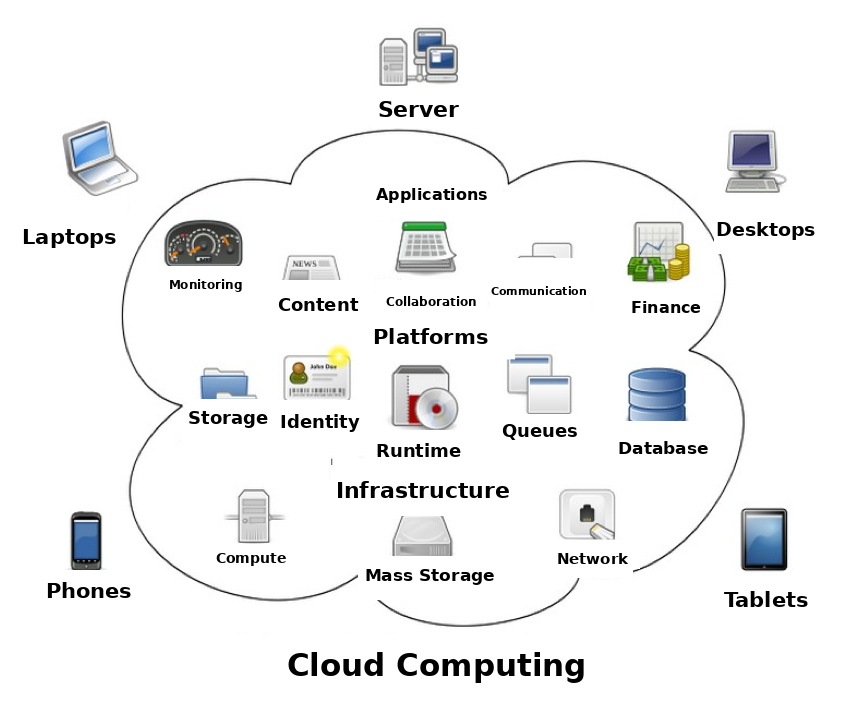 Cloud Computing Architecture and Layers
Overview of cloud computing showing client endpoints, application services, platforms, and underlying infrastructure.
Cloud computing is the on-demand delivery of computing resources—including compute power, data storage, database systems, networking, task scheduling, and analytics—over the Internet, without requiring local management or ownership of physical infrastructure by end users. By abstracting underlying hardware into elastic virtual pools, cloud computing enables organizations to scale workloads dynamically, automate software updates and backups, and reduce upfront capital expenditure (CapEx) in favor of flexible operational expenditure (OpEx).
How it works
When an end user accesses a cloud-hosted application or web service, several distributed networking components collaborate in real time:
- IP-Based Geolocation: The client's Internet Protocol (IP) address is analyzed to identify their approximate geographic location and network point of presence.
- Anycast & GeoDNS Routing: Global Domain Name System (DNS) resolvers direct client requests to the nearest edge location or Content Delivery Network (CDN) point of presence, reducing latency and serving localized regional assets.
- Load Balancing & Ingress: Ingress controllers and application load balancers distribute incoming HTTPS traffic across redundant backend compute clusters and availability zones.
- Microservices & Multi-Tier Processing: Frontend web interfaces query underlying microservices and RESTful APIs to execute business logic, read and write database records, and render dynamic responses concurrently.
Technical description (technical specifications)
Cloud computing is frequently compared to traditional public utilities such as electricity, water, or telecommunications networks. Consumers plug into the electrical grid to draw power whenever needed without having to understand grid topology, generator mechanics, or high-voltage transformer stations. Similarly, cloud computing abstracts the underlying physical servers, SAN storage fabrics, and routing topology away from developers and enterprises.
The National Institute of Standards and Technology (NIST Special Publication 800-145) provides the industry benchmark definition of cloud computing:
"A model for enabling ubiquitous, convenient, on-demand network access to a shared pool of configurable computing resources (e.g., networks, servers, storage, applications, and services) that can be rapidly provisioned and released with minimal management effort or service provider interaction."
Most enterprise cloud infrastructures consist of services delivered through hyperscale data centers managed by third-party Cloud Service Providers (CSPs). Commercial offerings are governed by formal Service-Level Agreements (SLAs) guaranteeing specific Quality of Service (QoS) metrics, uptime thresholds (such as 99.99% availability), and automated fault recovery.
Overview
Comparisons
Cloud computing inherits concepts from, and often intersects with, several related architectural paradigms:
- Autonomic Computing: Computing systems capable of self-management, self-configuration, self-healing, and dynamic resource optimization without human intervention.
- Client-Server Model: Distributed computing structures that partition tasks or workloads between service providers (servers) and service requesters (clients).
- Grid Computing: A distributed computing paradigm where heterogeneous, geographically dispersed computers are loosely coupled to solve massive, compute-intensive scientific and computational problems.
- Mainframe Computing: Centralized, high-throughput systems designed by enterprises for mission-critical bulk data processing, transaction processing (OLTP), and enterprise resource planning (ERP).
- Utility Computing: The packaging of compute, storage, and networking resources as a metered service billed on consumption, analogous to public utility metering.
- Peer-to-Peer (P2P) Architecture: Decentralized systems where participants share processing, storage, or bandwidth directly without the need for central coordination.
- Service-Oriented Architecture (SOA): A software design style where services communicate via discrete protocols over a network, creating the foundational building blocks for modern Software as a Service (SaaS).
Characteristics
The defining premise of cloud computing is that computing and data storage are decoupled from specific local physical machines. Computation takes place within a virtualized, highly redundant pool of infrastructure distributed across enterprise-grade data centers rather than confined to an individual on-premises workstation or server rack.
Structure
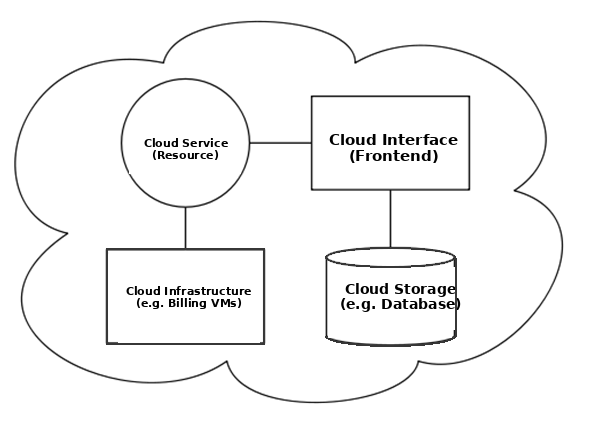 Cloud Computing Service Architecture: Frontend, Service Resource, Storage, and Infrastructure
Cloud service architecture model illustrating frontend interfaces, service resources, compute infrastructure, and storage systems.
Cloud system architecture consists of loosely coupled software components integrated via standard application programming interfaces (APIs). In accordance with the Unix philosophy of building modular, focused tools that connect cleanly, cloud platforms separate concerns between:
- The Frontend: The user-facing client environment, including web browsers, mobile applications, CLI tools, and terminal user interfaces used to interact with cloud services.
- The Backend: The provider-side infrastructure consisting of virtualization hypervisors, server clusters, message queues, container orchestrators, storage area networks (SAN), and security management controllers.
History
The metaphor of the "cloud" originated in telecommunications network schematics during the 1960s and 1970s, where an abstracted cloud shape was drawn to represent telephone switching networks and later the public Internet.
- Early Foundations: In 1961, computer scientist John McCarthy proposed that "computation may someday be organized as a public utility," anticipating the elasticity and on-demand consumption model.
- Virtual Private Networks (1990s): Telecommunications providers began replacing costly dedicated point-to-point data lines with Virtual Private Networks (VPNs), sharing underlying physical fiber links securely.
- Salesforce & Software as a Service (1999): Salesforce pioneered delivering enterprise business software directly over the web browser, eliminating local on-premises installations.
- Amazon Web Services (2006): Following the dot-com bubble, Amazon modernized its excess server capacity and launched Elastic Compute Cloud (EC2) and Simple Storage Service (S3), formalizing the modern utility computing era.
- Industry Research & Open Standards (2007–2008): Google, IBM, and leading research universities established academic cloud computing testbeds. In 2008, Eucalyptus emerged as the first open-source, AWS-API-compatible platform for private cloud deployments.
Essential characteristics
The National Institute of Standards and Technology (NIST) outlines five foundational characteristics of cloud systems:
- On-Demand Self-Service: Consumers can unilaterally provision computing capabilities, such as server runtime and network storage, automatically without requiring human interaction with each service provider.
- Broad Network Access: Capabilities are available over the network and accessed through standard mechanisms that promote use by heterogeneous thin or thick client platforms (mobile phones, tablets, laptops, and workstations).
- Resource Pooling (Multi-Tenancy): Provider computing resources are pooled to serve multiple consumers using a multi-tenant model, with different physical and virtual resources dynamically assigned and reassigned according to consumer demand.
- Rapid Elasticity: Capabilities can be elastically provisioned and released, in some cases automatically, to scale rapidly outward and inward commensurate with demand.
- Measured Service: Cloud systems automatically control and optimize resource use by leveraging a metering capability at some level of abstraction appropriate to the type of service (e.g., storage, processing, bandwidth, and active user accounts).
- High Availability & Fault Tolerance: Geographic multi-region deployments and automated failover ensure business continuity and disaster recovery in the event of hardware or data center outages.
- Economic Agility: Capital expenditures (CapEx) on physical data center real estate, cooling, and hardware refreshes are converted into predictable operational expenses (OpEx), lowering market barriers to entry.
Layers
Once network connectivity is established, cloud services are organized into primary functional layers:
Client Layer (User Agent)
The client layer consists of the hardware and software endpoints that end users employ to access cloud services:
- Thick Clients: Traditional desktop computers and workstations running rich client software that offloads part of the processing locally.
- Thin Clients: Low-overhead devices and terminals relying almost entirely on cloud servers for computational execution, graphics rendering, and storage.
- Web Browsers & Mobile Clients: Standard browser environments (Chrome, Firefox, Safari) and mobile operating systems (iOS, Android) communicating via HTTPS and WebSockets.
Infrastructure Layer
Infrastructure as a Service (IaaS) provides raw, virtualized physical computing resources over the network. Rather than purchasing servers, disk arrays, and networking hardware, organizations rent compute instances, software-defined networks (SDN), and block storage from providers like AWS, Microsoft Azure, and Google Cloud.
Applications
- Platform as a Service (PaaS): Delivers a pre-configured runtime environment, database management systems, and development tooling that allows engineers to deploy code without managing underlying operating systems or virtual machine patches.
- Software as a Service (SaaS): Delivers fully managed web applications directly to end users over the Internet. As explored in our deep-dive on SaaS architecture, SaaS solutions centralize maintenance, automate software updates, and utilize multi-tenant architectures to serve millions of concurrent subscribers.
Server
The physical compute tier consists of high-density rack servers, multi-core processor clusters, bare-metal nodes, and specialized virtualization hypervisors (such as KVM and VMware ESXi) that partition physical hardware into isolated virtual machines and containers.
Deployment models
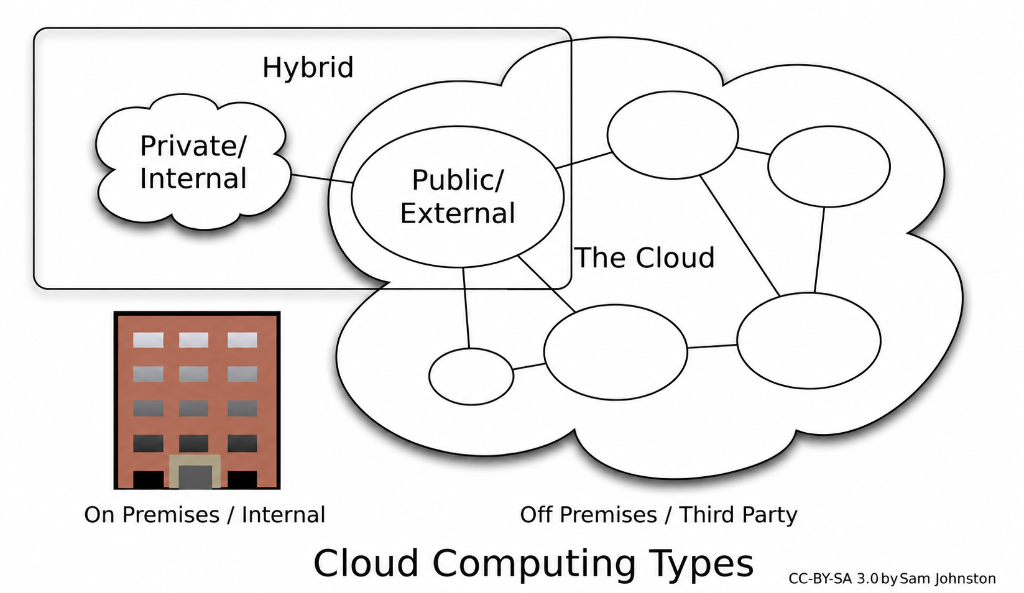 Cloud Computing Deployment Types: Public, Private, and Hybrid Cloud Architecture
Cloud computing deployment models: private internal clouds, public third-party clouds, and hybrid integration.
Public cloud
In a public cloud, compute, storage, and networking resources are owned and operated by a third-party Cloud Service Provider (CSP) and delivered over the public Internet. Public clouds offer near-infinite scalability, elastic pay-as-you-go pricing, and eliminate data center maintenance responsibilities.
Community cloud
A community cloud is shared among several organizations with shared concerns, regulatory mandates, or security requirements (e.g., healthcare consortia, financial networks, or joint research initiatives). Costs are distributed across member organizations while maintaining tailored governance policies.
The hybrid cloud and the delivery of hybrid information technology
The primary responsibility of enterprise IT departments is delivering responsive, secure computing services. As organizations adopt cloud methodologies while retaining legacy on-premises workloads, hybrid IT delivery has become the predominant enterprise architecture:
- Hybrid Cloud Integration: Combines internal private data centers with public cloud infrastructure, connected via secure VPNs or dedicated direct-connect circuits.
- Workload Tiering & Archiving: Frequently accessed transactional data remains in high-performance local clusters, while long-term backups, archives, and disaster recovery snapshots are replicated to scalable public cloud object storage.
- Hybrid Web Hosting: Modern web architectures distribute stateful application components and database tiers across dedicated hardware while offloading dynamic web traffic and static media assets to elastic public cloud servers.
Hybrid cloud
A hybrid cloud environment facilitates seamless workload portability between private data centers and external public providers. By unifying infrastructure management planes, organizations can scale public cloud compute during peak demand periods ("cloud bursting") while retaining sensitive data within private compliance boundaries (such as PCI-DSS payment vaults).
Private cloud
Douglas Parkhill first described the concept of a private computer utility in his 1966 work The Challenge of the Computer Utility, comparing computational infrastructure to dedicated on-site power generators. In modern enterprise architecture:
- Single-Tenant Infrastructure: A private cloud provides dedicated computing, networking, and storage provisioned exclusively for one organization.
- On-Premises or Hosted: Infrastructure may be housed in a corporate data center or hosted off-site by a managed service provider with dedicated hardware partitioning.
- Total Governance: Private clouds grant complete administrative control over security policies, network routing, and compliance audits, making them essential for financial institutions, defense organizations, and mission-critical government operations.
Cloud architecture
Cloud architecture refers to the systematic methodology and components required to conceive, build, and maintain distributed cloud platforms. It spans microservices design, API gateway routing, container orchestration (such as Kubernetes), infrastructure as code (IaC), and automated deployment pipelines that guarantee system resilience and scale.
Cloud storage
Cloud storage abstracts physical disk arrays and network-attached storage into scalable, fault-tolerant virtual storage pools accessible via web APIs:
- Object Storage: Unstructured data storage (e.g., AWS S3, Google Cloud Storage) organizing data as objects with unique identifiers and metadata, ideal for media files, backups, and data lakes.
- Block Storage: High-performance, low-latency volumes (e.g., AWS EBS) attached to virtual machines for operating system disks and transactional databases.
- File Storage: Network-attached storage (NAS) exposing standard network file system protocols (NFS, SMB) for concurrent multi-instance read/write access.
Intercloud
The Intercloud represents a federated "network of clouds"—an open, interconnected global ecosystem where distinct cloud providers seamlessly exchange workloads, services, and storage. Similar to how the Internet federated isolated computer networks, the Intercloud enables dynamic workload arbitrage, disaster failover between competing providers, and global latency reduction without vendor lock-in.
Issues
Privacy
Hosting sensitive consumer and corporate data on multi-tenant cloud platforms introduces significant privacy challenges. Organizations must maintain rigorous cryptographic separation, zero-trust access controls, and transparent data processing policies to protect user privacy against unauthorized surveillance, provider insider threats, or secondary data exploitation.
Commitment
To maintain enterprise compliance with legal and statutory requirements, cloud architectures must adhere to strict regulatory standards:
- Federal Standards: Adherence to the Federal Information Security Modernization Act (FISMA) for public sector and government data systems.
- Healthcare Regulations: Compliance with the Health Insurance Portability and Accountability Act (HIPAA) safeguarding electronic protected health information (ePHI).
- Financial Reporting: Strict internal control audits aligned with the Sarbanes-Oxley Act (SOX) for public corporations.
- Industry Audits: Attainment of SOC 1, SOC 2, and SOC 3 reporting standards, as well as ISO/IEC 27001 certifications across cloud provider data center facilities.
Legitimacy and legality
Jurisdictional questions arise when data is replicated across international data centers. Cloud service agreements must clearly define legal jurisdiction, data ownership, export controls, and procedures in response to foreign subpoena requests. Historical disputes—such as Dell's attempt to trademark the generic term "cloud computing" in 2008, which was quickly cancelled by trademark authorities—illustrate the necessity of protecting foundational technologies as open, accessible public domains. Furthermore, government procurement battles have highlighted the importance of open standards to prevent public sector vendor lock-in.
Open source
Open-source software forms the cornerstone of cloud computing infrastructure. From the Linux operating system kernel and KVM hypervisors to Kubernetes, Redis, and PostgreSQL, open-source technology powers the majority of hyperscale cloud deployments. Software licenses, including the Affero General Public License (AGPL), were specifically engineered to address network-hosted software services and preserve open collaboration.
Open standards
Most cloud providers offer documented application programming interfaces (APIs), yet proprietary implementations can create architectural lock-in. Industry consortia and standards bodies actively develop open specifications to facilitate multi-cloud interoperability, standardized workload definitions, and portable containerized deployments.
Security
Security in the cloud is governed by the Shared Responsibility Model:
- Provider Responsibility ("Security OF the Cloud"): The cloud provider secures the physical data centers, host operating systems, virtualization layer, and underlying networking hardware.
- Customer Responsibility ("Security IN the Cloud"): The enterprise secures customer data, user access credentials, network firewall rules, data encryption, and application code.
The Cloud Security Alliance (CSA) serves as the premier non-profit authority promoting best practice frameworks, Cloud Controls Matrix (CCM) standards, and third-party security assurance across cloud ecosystems.
Facilitation and performance
Enterprise adoption hinges on reliable availability, high throughput, and consistent application performance. Cloud service providers mitigate disruptions through multi-region redundancy, automated health probes, and aggressive Service-Level Agreements (SLAs). Enterprises actively monitor provider dependencies to protect business operations against infrastructure outages or provider insolvencies.
Sustainability and positioning
Hyperscale cloud data centers consume massive electrical energy for compute operations and server cooling. Modern cloud engineering emphasizes environmental sustainability and green computing through high-efficiency power architectures, evaporative cooling techniques, and locating new data center builds near renewable hydroelectric, wind, and solar installations to minimize carbon footprints.
Research
Academic institutions, national laboratories, and commercial vendors conduct extensive scientific research on distributed systems:
- Academic Research Initiatives: Major universities—including MIT, Carnegie Mellon, UC Berkeley, Georgia Tech, and IIT Bombay—drive fundamental advancements in distributed consensus algorithms, serverless runtimes, and hyper-scalable storage.
- Open Cirrus: A landmark global research testbed founded by Hewlett-Packard (HP), Intel, and Yahoo in cooperation with the National Science Foundation (NSF) to advance distributed systems and data center management research.
- Open Networking Foundation (ONF): An industry consortium founded by Google, Microsoft, Yahoo, Deutsche Telekom, and HP to advance Software-Defined Networking (SDN) and decouple control planes from packet-forwarding hardware.
Criticism of the term
During the initial rise of cloud computing, critics questioned whether the term represented a genuine technological revolution or an aggressive marketing rebrand of established client-server, time-sharing, and virtualization technologies. Notably, Oracle executive Larry Ellison remarked that cloud computing simply described established enterprise architectures under a new label. Over time, however, the synthesis of rapid elasticity, automated self-service orchestration, global distributed networking, and consumption-based pricing proved that cloud computing constitutes a profound and permanent paradigm shift in modern software engineering.


